
Container Leasing Terms: What to Check Before You Sign
A container lease comes down to six terms: how long you hold the box, what it costs per month, what delivery and pickup add, who pays for damage, what you may do to the container, and how it leaves your site. Get those six right in writing and a lease is one of the cheapest ways to add storage, cold storage or a site office for a project, a holiday peak or a renovation. At Conexwest, storage containers for rent come with delivery and pickup services, so the start and end of the lease are part of the same order.
This guide is for the people who rent containers to run a business: contractors, retailers, restaurants, event planners, municipalities, airports, hotels and park crews. It is not about the ocean-shipping leases that carriers sign by the thousands.
TL;DR
- Match the term to the job: short-term rental for a peak season or a project, longer terms for ongoing storage, and a purchase when you will keep the container for years.
- Budget for more than the monthly rate: delivery and pickup are usually billed separately, and permits and special features add to the total.
- Put the damage clause in plain terms: normal wear belongs to the owner, misuse (overloading, forklift punctures, forced entry) belongs to you.
- Prepare the site before delivery. A truck needs level ground and a straight approach, and soft or sloped ground can warp a door frame.
- At pickup, photograph every surface and keep the condition record. It is your evidence if a charge is disputed.
Table of Contents
- Lease, rental, rent-to-own: what the words mean
- What a container costs per month
- Delivery and pickup: the fees people forget
- The clauses to read before you sign
- Container return: what happens at the end of the lease
- A pre-signing checklist
- Promo: containers sized to the job
- Our perspective
- FAQ
- Sources
Lease, rental, rent-to-own: what the words mean
In everyday US business use, “leasing” and “renting” a container overlap. The difference is mostly in how long you commit and what happens at the end.
Short-term rental. You pay a monthly rate for as long as you need the container, often from one month up. This fits event staging, a retailer’s holiday inventory, a kitchen remodel or a construction phase with an end date. Rates usually fall per month as the term gets longer.
Long-term lease. You commit to a fixed period, which gives you a steadier rate and a container reserved for you. In the shipping industry, the long-term “dry lease” is typically written so the lease covers roughly half of the container’s useful life, which is how the owner recovers the purchase cost. For a business renter, the practical meaning is simple: the longer the commitment, the more the contract is really a payment plan for the box, and the more it is worth comparing with buying.
Lease-to-own. Some programs let rental payments count toward ownership or set a buy-out price at the end. Ask for that price in writing at the start, not at the end.
Buying. If you expect to keep the container beyond a year or so, compare the numbers before you commit. Our guides on renting versus buying a shipping container and rental and sale costs side by side walk through that math, and shipping containers for sale are available if the answer is to own.
Which term fits which reader
| Situation | Usual fit |
|---|---|
| Holiday inventory overflow for a retail store | Short-term rental, a few months |
| Jobsite storage or a site office for one project | Rental sized to the schedule, with a month-to-month extension if the job slips |
| Furniture storage during a home renovation | Short-term rental |
| Restaurant or event cold storage | Short-term for an event, longer for seasonal peaks |
| Airport, hotel or park maintenance storage that never goes away | Long-term term or purchase |
What a container costs per month
The monthly rate is only the starting point, but you need a sense of the range. Angi’s 2026 data, updated October 29, 2026, puts the national average at $125 per month, with most rentals between $75 and $200. By size, 10-foot units run $50 to $125, 20-foot units $100 to $150, and 40-foot units $150 to $250 per month.
Duration changes what you pay in total. The same source lists one month at $75 to $300, three months at $200 to $900, six months at $400 to $1,800 and one year at $900 to $3,600. These are national figures for plain storage units and move with the market, so treat them as a way to sanity-check a quote, not as a price.
What moves the price from there:
- Size and condition. A 40-foot unit costs more than a 20-foot, and a newer container more than an older one.
- Special features. Refrigeration, air conditioning, insulation and heating all add to the rate, according to the same Angi data. That matters for restaurants, food retailers and anyone converting a box into an office.
- Permits. Angi lists permit fees of $15 to $500. Cities and municipal projects often have their own placement rules, so check them before you order.
- Delivery and pickup. Covered next.
We do not publish a flat price list for rentals, because the right quote depends on size, features and where the container goes. Our rental options include 20ft containers, 20ft open-side containers and 40ft containers with doors on both ends, which suit loading from either end.
Delivery and pickup: the fees people forget
A low monthly rate can hide a large total if delivery and pickup are billed on top. One 2026 lease-agreement guide says they are usually billed separately at $100 to $400 each way, depending on distance and the truck required. That is two charges, not one, so your budget should include both.
Some other equipment rentals simply bundle the two into one price. Roll-off dumpsters are an example, where delivery and pickup pricing is included in a flat rate. When you compare container quotes, ask the same question: is it one price or three line items?
For a full picture of how distance and truck type drive cost, see our guide to shipping container delivery costs. We deliver to 48 states, and you can read about nationwide container delivery before you order.
Site access decides whether delivery goes smoothly
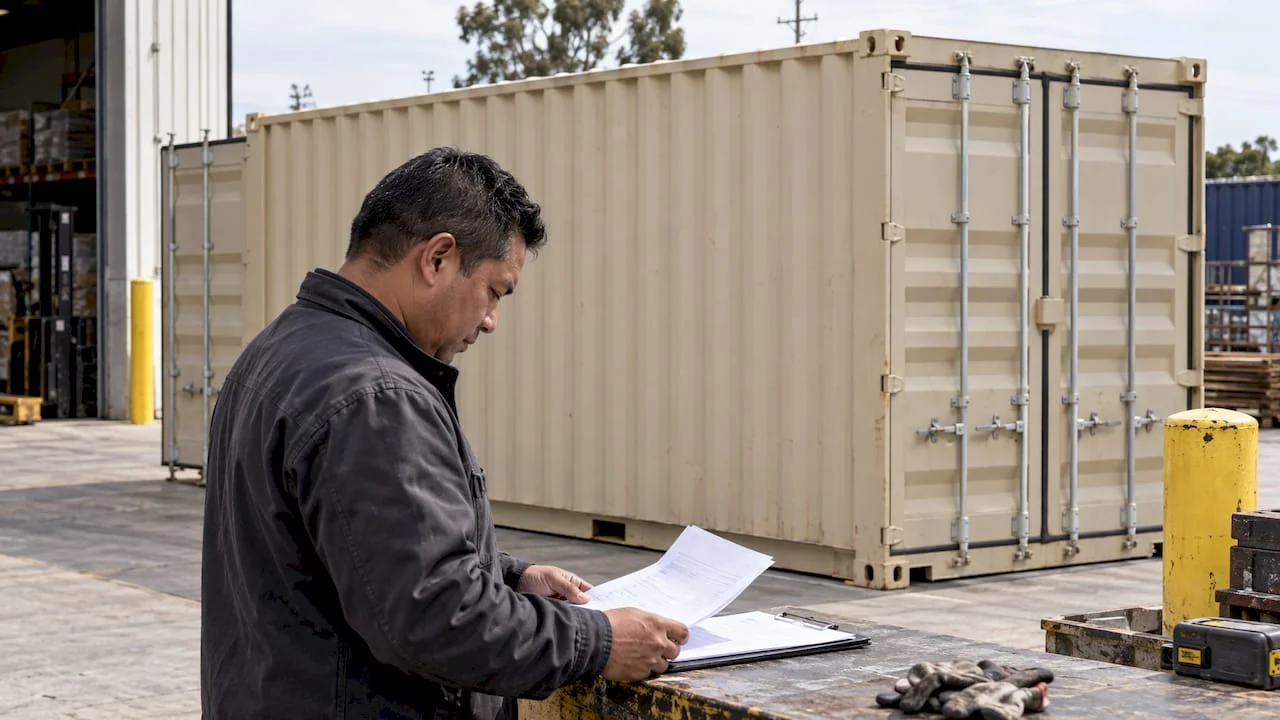
The delivery truck, usually a tilt-bed or roll-off, needs level ground and roughly 100 feet of straight clearance, and placing a container on soft or sloped ground can warp the door frame. A failed delivery attempt can cost you a second trip charge and a day of schedule.
Before the truck arrives:
- Measure the drop zone and the route to it, including gate width, overhead lines and turns.
- Level and firm the ground. Gravel or compacted base works better than turf after rain.
- Keep vehicles, materials and people out of the unloading path.
- Confirm who will be on site to direct the driver.
Our delivery requirements checklist and access checklist for route and site cover each of these in more detail.
The clauses to read before you sign
An agreement should state the lease length, the monthly cost, the container type and condition, who is responsible for maintenance, and the delivery day, time frame and location. Beyond that basic list, look for these.
Term and extension
Say how long the initial term runs, whether it renews automatically, and what the rate is if the job runs over. Construction schedules slip, and a month-to-month extension at a known rate is worth more than a clause you only discover when the term ends.
Deposit and payment
Find out whether there is a security deposit, how much, and when it is returned. Ask what the invoice date schedule is, because recurring rental is billed on a cycle.
Damage and wear
A well-written damage clause assigns normal wear to the owner and damage from misuse to the renter. Typical misuse examples are overloading, forklift punctures, forced entry and rust from stored chemicals, and the renter is expected to report damage promptly. Many owners pair this with a hold-harmless provision.
Practical consequences for you: do not store corrosive chemicals in a standard storage container, keep forklifts away from the walls, and lock the box. If your use includes hazardous materials, the right answer is a container built for it. Conexwest offers hazmat containers and container customizations.
Permitted use and modifications
A standard rental agreement is written for storage. If you want to cut a door, add power, install shelving or turn the box into an office, the lease must say so. Modifications are best done to a container made for it, such as an office container or a cold storage unit, rather than altering a basic storage box mid-lease.
Insurance and liability
Clarify whether the contents are covered. Owners generally insure their equipment, not what you put in it, so check your own commercial property policy with your insurance agent before you load inventory, tools or food.
Placement and local rules
Municipal codes, HOA rules and permit requirements for containers vary by city and county. Your contract should say who obtains any permit. Check with your local building or zoning office for the rules where the container will sit.
Container return: what happens at the end of the lease
There are two different worlds here, and it helps to know which you are in.
In ocean shipping, a leased container goes back to a depot. The customer obtains a Redelivery Authorization number from the lessor, sometimes with several working days’ notice, arranges trucking to the assigned depot, and the gate records the container’s condition on an Equipment Interchange Receipt. The depot then surveys for damage, may charge for lifting and cleaning, and the final settlement is reconciled against any deposit. If the depot rejects the container, daily charges can continue.
For a business renting a storage container delivered to its site, return is usually simpler: the provider picks the container up from where it was placed. The principles carry over, though: schedule it, empty it, document it, and get the end date recorded so billing stops.
A return routine that protects you
- Give notice early. Check how many days the contract requires before pickup, and put the request in writing.
- Empty and sweep the container. Remove all contents, debris, stickers, and anything fastened to the walls or floor.
- Walk the container. Check the floor for holes or soft spots, the walls and roof for dents or punctures, the door gaskets for a good seal and the locking bars for smooth operation.
- Photograph everything. Take date-stamped, high-resolution photos of every interior and exterior surface, and compare them with the condition report from delivery to separate pre-existing marks from new ones.
- Clear the pickup path. The truck needs the same room to work that it needed on delivery. Move vehicles and materials away.
- Confirm the condition record. Do not sign a condition receipt that does not match what you see, ask for amendments before signing, and keep copies for at least two years, as this return guide advises.
- Get confirmation that billing has stopped. Rental charges typically run until the owner records the container as returned, so ask for the end date in writing.
Documented evidence beats verbal claims in a charge dispute, which is why the delivery-day photos matter as much as the pickup-day ones. Take them the hour the container lands, before you load anything.
If you manage many projects, build this routine into your closeout list the way you would a punch list. Pickup is a line item, not an afterthought. Conexwest provides pickup services for rented storage containers, so the return is arranged with the same company that delivered.
A pre-signing checklist
- Monthly rate, and the length of term it applies to
- Delivery and pickup fees, each way
- Deposit amount and refund timing
- Container size, type, age and condition at delivery
- Who handles permits and placement approval
- What counts as normal wear and what counts as damage
- What modifications are allowed, and who performs them
- Extension rate and notice period for pickup
- Insurance responsibilities for the container and its contents
Promo: containers sized to the job
Whether you need holiday overflow, a jobsite office, cold storage for a restaurant or a locked box for park equipment, you can browse sizes, add customizations and order online. Conexwest has delivered over 30,000 containers and serves clients across 48 states.
Start with storage containers for rent, or look at cold storage and office containers if the job needs more than storage. For a broader view of how leasing fits a project, read our guide to container leasing for flexible jobsite space and container logistics for site operations.
Our perspective
Most leasing problems we see described by customers come from the same gap: the monthly rate is clear, and everything around it is not. Delivery, pickup, placement and the condition of the box at the end are where a rental either runs smoothly or turns into a dispute.
That is why we think of a container order as a complete job, not a rate. Our online ordering lets you choose the container, add customizations such as office conversions, cold storage, hazmat storage, roll-up doors, lockboxes and paint, and arrange delivery and pickup in the same place. A turnkey approach means fewer vendors to coordinate and one company accountable from drop-off to pickup.
For businesses that run on schedules, such as contractors, retailers heading into the holidays and municipal project teams, that matters more than shaving a few dollars off a monthly figure. Plan your site, read your terms, document the condition, and choose a provider that handles the whole logistics chain.
Conexwest
FAQ
How much does it cost to rent a shipping container per month?
Angi’s 2026 data gives a national average of $125 per month, with most rentals from $75 to $200, depending on size and duration. Delivery, pickup, permits and features such as refrigeration add to that. Request a quote for your size, location and use for an exact figure.
Can I rent a container for just one month?
Yes. Short-term rentals are common for events, holiday inventory and renovations. One-month rentals typically cost more per month than longer terms, so if your project could run over, ask about the extension rate up front.
Who pays if the container is damaged?
Usually the owner absorbs normal wear, and the renter pays for damage from misuse such as overloading, forklift punctures, forced entry or rust from stored chemicals. Report any damage promptly and keep dated photos from delivery and pickup.
What do I need to do before the container is picked up?
Empty it, sweep it, photograph every surface, and clear a straight, level path for the truck. Give the notice your contract requires and get written confirmation of the pickup date so billing ends on time.
Sources
- Shipping Container Rental Cost [2026 Data], Angi
- Characteristics of Container Leasing Arrangements, Port Economics, Management and Policy
- Shipping Container Lease Agreement Template, Contractable
- How To Rent A Shipping Container, NTS Logistics
- How to Return an Off-Hire Container: Steps and Fees, LegalClarity
- Flat-rate dumpster rental pricing