
Container Rental Pickup Process: Steps, Prep and Fees
The pickup of a rented storage container is a short, predictable sequence: you empty and clean the unit, confirm the end of your rental term, schedule a pickup date, clear the route for the truck, and let the driver load the container and leave. Most delays and surprise charges come from two things: a late or vague pickup request, and a site the truck can no longer reach. This guide walks through each step, so a job site manager, store operations lead, event planner or homeowner can close out a rental without paying for an extra month.
If you are renting from Conexwest, pickup services for storage containers are part of our storage container rental offer, and we deliver across 48 states.
TL;DR
- Pickup starts with a call or request to the rental company once the container is empty, not on the day your project ends.
- Empty, sweep and unlock the container, and clear the route and the area around it before the driver arrives.
- The truck needs the same access the delivery truck needed. If conditions changed, fix them first.
- Pickup fees, weekend surcharges and a missed monthly cutoff are the main costs to avoid.
- Check your agreement for the notice period, the condition standard and what counts as the end of the term.
Table of Contents
- How the pickup process works, start to finish
- Step 1: Match the pickup date to your rental term
- Step 2: Empty and clean the container
- Step 3: Remove your lock and secure the doors
- Step 4: Request the pickup
- Step 5: Prepare the route and the site
- Step 6: What happens when the driver arrives
- Step 7: Check the site and keep your records
- What pickup costs and what causes delays
- Local rules that can affect pickup
- Promo: rent a container with pickup built in
- Our perspective: plan the pickup when you plan the delivery
- FAQ
- Sources
How the pickup process works, start to finish
Pickup mirrors delivery in reverse. A tilt-bed or flatbed truck backs up to the container, the driver winches or slides it onto the bed, secures it and drives away. The work on your side happens before that truck arrives.
| Step | What you do | What goes wrong |
|---|---|---|
| 1. Plan the end date | Match the pickup request to your project schedule and rental term | Requesting pickup after the term ends and paying another month |
| 2. Empty and clean | Remove all contents, debris and trash, sweep the floor | Leftover items that delay loading or trigger cleaning charges |
| 3. Remove your lock | Take off padlocks and lockboxes, close and latch the doors | A locked box the driver cannot open |
| 4. Request pickup | Contact the rental company with the address, container ID and a date | Vague timing, no one reachable on the day |
| 5. Clear the route | Move vehicles, materials and equipment away from the container and path | A blocked truck and a failed pickup |
| 6. Be reachable | Keep your phone on and have someone on site if possible | Missed driver calls |
| 7. Check the spot | Photograph the container and the ground after it leaves | Disputes about damage or site condition |
Step 1: Match the pickup date to your rental term
Rental containers are usually quoted by the month. Standard quotes include 30 days, so a small scheduling gap can trigger a full extra month, and the same guide notes that pickup fees are charged on top of the rental. Whatever your provider’s exact billing terms are, the habit is the same: decide your last day of use, count backward, and ask for pickup early enough that the truck can actually arrive inside the term.
Three questions to settle before you request pickup:
- When does the term end? Find the billing date in your rental agreement, not just the date you stop using the unit.
- How much notice does the agreement require? Requirements differ by provider and location, and truck availability depends on your area and season. Peak periods such as the holidays or a busy construction season are the times to ask earlier.
- Do you need an extension? If a project slips, extending is usually cheaper and simpler than a pickup that has to be rescheduled and repeated.
If you are still deciding between a rental and a purchase for a long project, our comparison of renting versus buying a shipping container shows where the break-even tends to fall, and the guide to cargo container rental and sale costs puts the numbers side by side.
Step 2: Empty and clean the container
A container goes back empty. That means furniture, inventory, tools, pallets, paint cans, packing material and trash all come out. A broom-clean floor is the standard to aim for.
Who this matters most for:
- Contractors and municipalities: Job site containers collect screws, cut-off material, spilled sealant and fasteners. Sweep them out, and remove any shelving or racks you bolted or screwed in.
- Retailers and chain stores: Holiday inventory leaves in stages. Plan the final pallet removal for the day before pickup, so nothing is left behind.
- Restaurants and cold storage users: Remove all food, wipe down interior surfaces and let the unit drain and dry before pickup.
- Homeowners: Furniture and boxes should be fully out, and the doors latched afterward.
If you modified the container, for example with shelving, interior lighting, vents or an office layout, find out what the agreement says about returning it to its original condition. Container Transport notes that a renter who converts a unit can be liable for the cost of restoring it. Our modification options are built for purchased units, and a custom build from container customizations is a better fit when the space is meant to stay.
Step 3: Remove your lock and secure the doors
Take off your padlock or lockbox and close the doors firmly so the latch bars seat properly. A door that swings open on a truck bed is a safety problem, and a locked door the driver cannot open can end the visit with nothing moved.
If you used an outside lock on a unit holding valuable materials, keep the key with you until the last item is out, then remove the lock yourself.
Step 4: Request the pickup
Contact the rental company when the container is empty or will be empty on a known date. Have this information ready:
- The delivery address, and the exact placement spot if the site is large
- Your rental agreement number or container ID
- A date and a time window that work for you
- A reachable phone number for the driver
- Any access changes since delivery, such as a new fence, gate code or parked equipment
Ask for confirmation in writing. Delivery companies generally work in time windows rather than exact minutes. Container One’s delivery guide is not our source for this, so treat the following as a planning habit rather than a rule: expect a window of a few hours, and plan for someone to be reachable by phone.
If the container sits at a location that is not staffed, such as a vacant lot or a park maintenance yard, tell the dispatcher in advance how the driver gets in and who to call from the gate.
Step 5: Prepare the route and the site
The pickup truck is longer and wider than the container, and the reality is simple: the route, not the container, is what blocks most pickups. Anything that was clear on delivery day may not be clear today.
Walk the path from the public road to the container and check:
- Vehicles and equipment: Move parked trucks, dumpsters, pallets and materials away from both sides of the container and along the access path.
- Overhead clearance: Tree branches grow and wires sag. A tilt bed raises during loading, so the driver needs clear space above the unit as well as in front of it.
- Gates and turns: Confirm gates are open and unlocked, and that nothing new narrows the turn.
- Ground condition: A site that handled the delivery in dry weather may be soft after heavy rain. A heavy truck can lose traction on wet grass, loose gravel or recently graded soil, and rescheduling is the usual result.
- Door direction: Make sure the doors are closed and nothing is leaning against them.
Our container delivery requirements checklist and access checklist for route and site apply equally on pickup day, since the truck needs the same room that delivered the unit.
A stable surface also matters. A gravel pad or compacted ground keeps the container level during the rental and makes the loading cleaner, and our guide to gravel pad foundations for commercial sites explains how to build one. Crews that grade or prepare a pad often use heavy equipment such as a RORO skip loader to move base material and debris.
Step 6: What happens when the driver arrives
The driver typically calls ahead, inspects the access route, positions the truck and loads the container. Your job on the day is short:
- Be reachable by phone, and be on site if the location needs gate access.
- Confirm the container is the right one, since some sites have several.
- Stay clear of the truck while the unit is being loaded. Keep people, vehicles and pets away from the bed and the container.
- Ask the driver to note the container’s condition and keep any paperwork or receipt.
If the driver cannot reach the container because of a blocked path or soft ground, the pickup is usually rescheduled. Ask the dispatcher beforehand whether a failed attempt carries a fee.
Step 7: Check the site and keep your records
After the truck leaves, walk the spot. Photograph the ground where the container sat, any gate or fence near the path and any marks on the surface. Marks on asphalt, concrete or turf from a container and a heavy truck are easier to resolve when you have before and after photos. Take photos at delivery too, and keep them with your agreement until the final invoice is paid.
What pickup costs and what causes delays
Pickup is billed separately from the monthly rental in most arrangements, and the price depends on the distance from the rental yard. Typical delivery and pickup fees run $150 to $450, and long-distance moves can be $800 to $1,000 fixed, based on that guide’s 2026 pricing. The same guide lists the items that add to a bill:
- Mileage charges on longer hauls
- Fuel surcharges that move weekly with Department of Energy national averages
- Weekend convenience surcharges of $100 to $200, which a mid-week pickup can avoid
- Extras such as parking permits, stairs or a repeat delivery
Those are a published range for moving containers in 2026, not a quote for your site. For a real number, ask for a line-item quote. If you want a reference for how delivery pricing is built, read how much shipping container delivery costs.
Three habits keep the bill predictable:
- Request pickup mid-week when your schedule allows.
- Book early in peak periods such as holiday retail season and spring construction.
- Fix access problems before the truck arrives, not after a failed attempt.
Weather can also shift schedules. Heavy rain, snow and ice slow trucks and soften ground, so build a few days of slack into any project that depends on the container leaving by a fixed date.
Local rules that can affect pickup
If your container sits on a public street, in a right of way or in a neighborhood with zoning limits, check with your city or county for placement and permit rules. Some places require a permit for a container on a street, and a pickup truck may need a temporary parking restriction to load. For private commercial property, the more common limits are fire lanes, easements and utility lines. Ask your local building or public works department before delivery, because the same rules apply when the container leaves.
Promo: rent a container with pickup built in
We rent storage containers in several sizes, including 10ft, 20ft and 40ft units, and offer pickup services for storage containers along with nationwide delivery. Our online ordering system lets you choose a container and its options in a few clicks, and for jobs that need cold storage, an office or a modification, our team can handle the customization. We have delivered more than 30,000 containers.
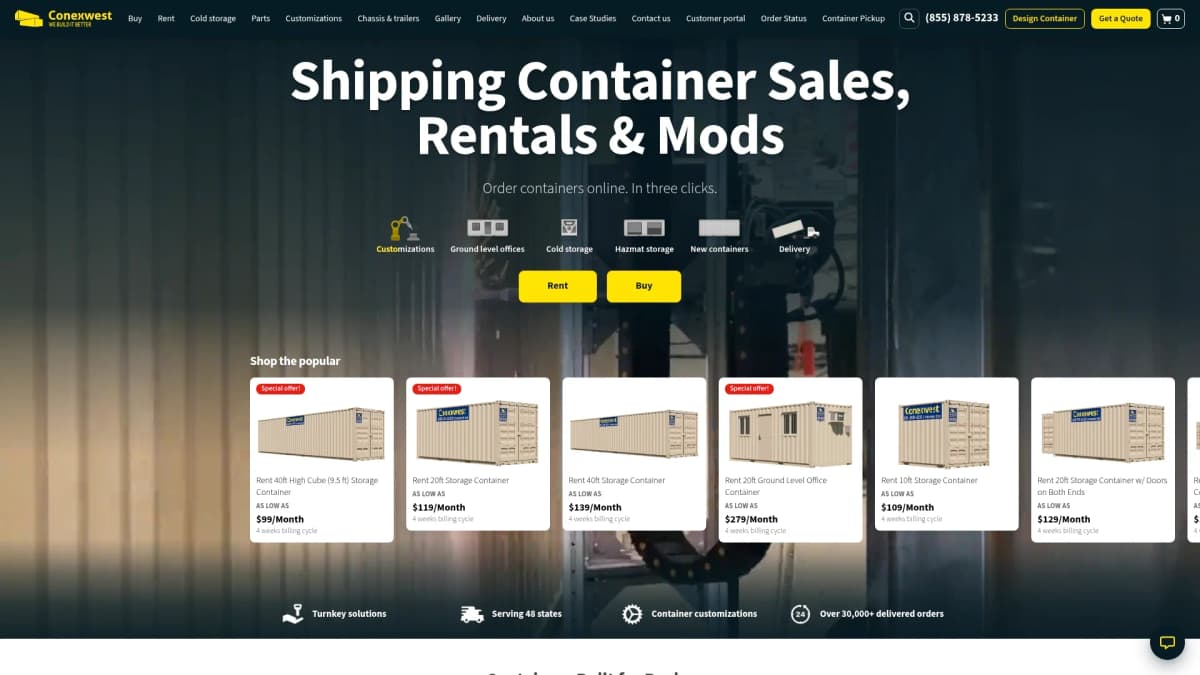
Start on the storage container rental page to choose a size and arrange delivery and pickup in one order.
Our perspective: plan the pickup when you plan the delivery
Most pickup problems start on delivery day. The spot where a container is placed decides how easy it will be to remove, so we encourage customers to think about the exit when they pick the entrance.
A level, firm pad, a clear approach, enough turning room and open gates make both visits quick. Customers who photograph the site on delivery day and walk the route again before pickup rarely have a surprise.
Our work with job sites, retailers, municipalities, restaurants and event teams has one thing in common: the rental ends when the project ends, and the project schedule is rarely exact. That is why we recommend keeping the pickup request flexible, confirming the term and giving the driver a phone number that gets answered.
A rental should add storage or workspace without adding work for your team. Delivery, placement and pickup are part of that, and we aim to make them one coordinated process.
Conexwest
FAQ
How far ahead should I schedule container pickup?
As soon as you know your last day of use, and earlier in peak seasons. Your rental agreement or provider sets the exact notice period, so confirm it when you order. Asking early gives dispatch room to find a mid-week slot.
Do I have to be there when the container is picked up?
Not always, but a reachable contact is important. If the site has a locked gate or several containers, have someone present or give the driver clear access instructions. The driver may need to confirm the unit before loading.
Does the container have to be empty and clean?
Yes. Remove all contents and trash, sweep the floor and take off your lock. If you modified the container, check the agreement for what condition it must be returned in.
What can delay or add cost to a pickup?
A blocked route, soft ground after rain, a locked container and a request that arrives after the monthly term ends. Fuel surcharges and weekend fees can also raise the bill, so a mid-week pickup with a clear path is the cheapest option.