
Container Branding for Marketers: 9 Ideas, U.S. Rules to Check
Container branding ranges from quick decals and banners to full vinyl wraps, cladding, and experiential fit-outs. The right method depends on your campaign objective, durability needs, and regulatory constraints, not just your budget. We offer customization and delivery for businesses that want a turnkey path from bare steel to finished branded asset, whether that container becomes a pop-up shop or a cold-storage unit parked behind a warehouse.
TL;DR:
- Corrugated steel favors cast vinyl wraps, while calendared vinyl suits flatter decal work; test adhesion first on refurbished units with old paint or oxidation.
- Transport containers must keep placards visible, avoid designs resembling placards, and preserve clearance; workplace hazardous material labels must group signal words, statements, and pictograms.
- Costs rise with permanence: banners install in a day, decals or paint take days, and wraps, cladding, or interior fit outs may require weeks.
- Ask suppliers for vinyl and paint UV stability specifications, written warranties, and maintenance plans before approving a design, especially for outdoor containers.
Table of Contents
- What Are the Best Container Branding Ideas?
- Which Materials and Methods Work Best on Corrugated Steel?
- What Regulations Affect Container Branding?
- How Do You Keep Branding Legible at a Distance?
- What Does Container Branding Cost and How Long Does It Take?
- How Does Conexwest Handle Branded Container Projects?
- What Surface Prep Does Branding Require?
- How Do You Update Branding Over a Container’s Lifecycle?
- Are There Sustainable Options for Container Branding?
- How Should Branding Match the Container’s Use Case?
- Choosing Branding by Goal, Not Just Budget
- Order or Customize a Branded Container With Conexwest
- FAQ
- Sources
What Are the Best Container Branding Ideas?
Container branding options fall into three effort tiers, and matching the tier to your goal saves money and avoids rework.
- Magnetic panels: removable, repositionable graphics that work well for rotating promotions or multi-site fleets.
- Banners and mesh wraps: inexpensive, temporary coverage ideal for events, trade shows, or seasonal campaigns.
- Decals and cut vinyl: mid-durability graphics for logos, contact information, or directional signage on static units.
- Vinyl wraps (full or partial): a photo-realistic, durable option suited to fleet branding and long-term outdoor placement.
- Exterior paint and murals: a cost-effective way to cover large surfaces with custom artwork or corporate colors.
- Cladding and architectural facades: a permanent transformation for containers used as retail units, offices, or venues.
- 3D signage and bolt-on elements: dimensional logos or lettering that add depth and visibility from a distance.
- LED and digital displays: active illumination for nighttime visibility or dynamic, changeable messaging.
- Interior branding and experiential fit-outs: custom interiors for pop-ups, showrooms, or hospitality activations.
Magnetic panels and banners are movable and temporary, which makes them the right call for short campaigns or containers that change locations often. Decals, paint, and wraps sit in the middle, durable enough for a season or two of outdoor exposure but still removable or refreshable. Cladding, 3D signage, LED displays, and interior fit-outs represent permanent or semi-permanent investments, better suited to containers with a fixed, long-term role such as a branded office or retail pod. For more inspiration on what a repurposed container can become, our breakdown of unique ways to use shipping containers covers several branding-friendly formats.
Which Materials and Methods Work Best on Corrugated Steel?
Corrugated steel is not a flat canvas, and that ribbed surface changes how materials behave. Vinyl wrap comes in two main types: cast vinyl conforms more easily to corrugation and curves, making it the better choice for wraps on ridged panels, while calendared vinyl is thinner, less flexible, and more appropriate for flat decal work or short-term signage.
Exterior paint systems need corrosion control before anything else. Surface prep (removing rust, cleaning salt residue, and applying a primer rated for steel) determines how long a paint job lasts. Cladding becomes the more practical option when a container will see years of use in harsh weather, since it adds a protective layer rather than relying on a coating alone.
- Banners and mesh typically attach with grommets, bungee cord, or magnetic strips, which avoids drilling into the container shell.
- Bolt-on signage hardware requires washers and sealant at every penetration point to prevent water intrusion through the corrugation.
- Decals adhere best to flat or lightly textured sections, away from deep ridges where air bubbles can form.
Pro Tip: Run a small adhesion trial on a scrap panel, especially on refurbished containers, since old paint and surface oxidation can behave very differently from the factory finish on a new unit.
What Regulations Affect Container Branding?
Branding a container used in regulated transport means working around placarding rules, not through them. Under 49 CFR 172.502, placards must stay visible and cannot be obscured by non-regulatory advertising, and designs that could be mistaken for a placard are prohibited outright. 49 CFR § 172.516 adds that placards must be kept clear of any marking that could reduce their effectiveness, with a recommended minimum separation of a few inches from other markings where practicable, a guideline worth building into your layout grid from the start, per DOT visibility requirements.
Separately, OSHA’s HCS 2012 standard requires that signal words, hazard statements, and pictograms stay grouped together on labels, and containers holding hazardous materials in a workplace setting still need that hazard information or accompanying shipping papers regardless of exterior branding.
- Confirm whether the container will ever transport or store hazardous materials before finalizing artwork placement.
- Coordinate branding zones with your carrier or supplier to leave clearance around existing marks.
- Avoid white square-on-point shapes or other elements that echo standard placard design.
How Do You Keep Branding Legible at a Distance?
Legibility is a design input you can measure, not a guess. Color contrast research shows that high-contrast combinations, such as black text on white or dark lettering on a light panel, substantially improve how far away a sign can be read, and the same research points to specific luminance ranges worth targeting for nighttime visibility.
- Favor strong luminance contrast over subtle color pairings, especially on large exterior panels.
- Size letters to the viewing distance: taller letters for roadside placement, smaller ones for pedestrian-level signage.
- Use retroreflective sheeting for passive nighttime visibility or active LED illumination for dynamic messaging.
The combination of high contrast and correct letter height matters more than font style, according to research on color contrast and legibility, which found that readability drops sharply once contrast or scale falls short of recommended thresholds.
What Does Container Branding Cost and How Long Does It Take?
Costs scale directly with permanence. Banners and magnetic panels sit at the low end and install in a day. Decals and paint fall into a mid-range band and typically take a few days depending on surface prep. Vinyl wraps, cladding, and interior fit-outs occupy the high end, often requiring one to several weeks depending on scope and whether custom fabrication is involved.
- Inspect vinyl seams and edges every few months for lifting, especially on units stored outdoors.
- Plan paint touch-ups on an annual cycle in coastal or high-humidity regions where corrosion moves faster.
- Service LED components on a regular schedule, since weather exposure shortens connector and driver lifespan.
Ask any supplier for UV-stability specs on vinyl and paint, a written warranty, and a maintenance plan before signing off on a design, since these details separate a branding job that lasts from one that fades within a season.
How Does Conexwest Handle Branded Container Projects?
We built our online ordering system so that customization, from paint to full modification, happens in the same workflow as the purchase or rental. We have delivered many containers across a wide service area, and we handle branding requests alongside structural modifications rather than treating them as an afterthought.
Our typical project moves through scope definition, surface preparation, material selection, installation, and a delivery verification step before the container leaves our hands.
- We confirm intended use early, whether the container becomes an office, cold storage unit, or logistics asset, since that shapes material choice.
- Surface prep and corrosion control happen before any paint or wrap goes on, consistent with our guidance on painting a shipping container.
- We coordinate delivery scheduling so branded units arrive ready for immediate use.
- Fit-out ideas, such as those in our container fit-out guide, inform interior branding options for experiential projects.
What Surface Prep Does Branding Require?
Branding only lasts as long as the surface underneath it is sound. Corrugated steel containers, especially used or refurbished units, often carry surface rust, salt residue, or old paint flaking at the seams, and any of those will undermine adhesion no matter how good the vinyl or paint is.
A standard prep sequence starts with washing down the exterior to remove dirt, oil, and loose debris. Rust spots need grinding or sanding back to bare metal, followed by a rust-inhibiting primer before any topcoat or adhesive goes on. Wrap installers typically also wipe down panels with isopropyl alcohol or a similar solvent right before application to remove any residual film that could weaken the bond.
New containers generally need less aggressive prep, often just a cleaning pass, since the factory finish has not had time to oxidize. Refurbished units are a different story: they may carry years of weathering, and skipping the rust treatment step is the most common reason a wrap or paint job fails early.
Humidity and temperature at the time of application matter too. Vinyl adhesives perform best within a moderate temperature range, and applying wrap in direct sun or cold conditions can cause bubbling or poor adhesion. Scheduling installation for a dry, moderate-temperature day pays off in how long the finished branding holds up.
How Do You Update Branding Over a Container’s Lifecycle?
A container often outlives a single marketing campaign, and the branding attached to it should be easy to refresh without damaging the shell underneath. Removable options like magnetic panels and banners are built for this: swapping artwork takes minutes and leaves no residue.
Vinyl wraps and decals are more involved to update. Removal generally requires heat to soften the adhesive, followed by a cleaning pass to strip any leftover glue before new graphics go on. Budgeting time for removal, not just installation, matters when planning a rebrand or seasonal refresh.
Paint is the least flexible to update quickly, since a full repaint means repeating the surface prep process, but it also tends to need refreshing less often if the original job included proper corrosion control. Cladding and architectural facades are typically treated as permanent, and updates usually mean replacing panels rather than repainting them.
For fleets with several branded containers, staggering updates on a rotation, rather than refreshing every unit at once, keeps costs predictable and avoids downtime across an entire inventory. Keeping a record of the materials and finish used on each container also speeds up future updates, since matching an existing wrap type or paint system is far easier with that information on hand.
Are There Sustainable Options for Container Branding?
Material choice affects both durability and environmental footprint. Vinyl wraps, while durable, are petroleum-based and generate waste when removed and replaced, which matters for brands running frequent campaign refreshes. Reusable options like magnetic panels and banners reduce material turnover since the same hardware gets reused across campaigns rather than discarded.
Paint systems vary in environmental impact depending on the formulation. Low-VOC exterior paints reduce emissions during application and are increasingly available from industrial coating suppliers, making them a reasonable substitute for standard solvent-based systems without sacrificing corrosion protection.
Cladding, while a larger upfront material investment, tends to last considerably longer than surface treatments, which can reduce the frequency of material replacement over a container’s working life. LED displays carry their own consideration: energy use during operation, which argues for sizing displays to actual visibility needs rather than defaulting to the largest available panel.
Reusing a shipping container itself is already a lower-impact choice compared to new construction, since the steel structure is repurposed rather than built from raw materials. Choosing branding methods that extend a container’s usable life, rather than ones that require frequent full replacement, keeps that advantage intact.
How Should Branding Match the Container’s Use Case?
The right branding approach depends heavily on what the container actually does once it is branded. A static storage unit sitting behind a facility mainly needs durable, low-maintenance branding, so decals or a painted logo usually cover the need without added upkeep.
Cold storage units, including blast freezer and SuperFreezer configurations, face different conditions: condensation, temperature swings, and frequent door operation. Branding on these units should prioritize materials rated for moisture exposure, and placement should avoid door seals, vents, and refrigeration unit housings entirely.
Office containers and ground-level offices, often used as semi-permanent workspace, are good candidates for more polished branding such as vinyl wraps, cladding accents, or interior fit-outs, since they represent a public-facing space rather than pure storage. Logistics and transport units carry the added constraint of placarding compliance, which limits where and how branding can be applied compared to a stationary unit. Matching the branding investment to how long the container stays in that role, and how visible it is to customers versus staff, keeps spending proportional to the payoff.
Choosing Branding by Goal, Not Just Budget
The most common mistake in container branding is picking a method based on sticker price rather than what the campaign actually needs. A quick trade show activation does not need cladding, and a permanent branded office does not belong on a magnetic panel that peels in the rain.
Decide first whether the priority is visibility, mobility, or experience, then let that decision drive material choice. A container that moves between sites every few weeks should never carry a finish that only makes sense for something staying put for years. Loop in your supplier early on placarding and transport plans, since a design that looks right on paper can still run into compliance trouble once the container goes on a truck.
— Conexwest
Order or Customize a Branded Container With Conexwest
We offer shipping containers for sale with fabrication and delivery handled in-house, so branding and structural work happen under one roof instead of being split across vendors. Our container modification services cover paint, cladding prep, and custom fit-outs for office, retail, or cold storage builds.
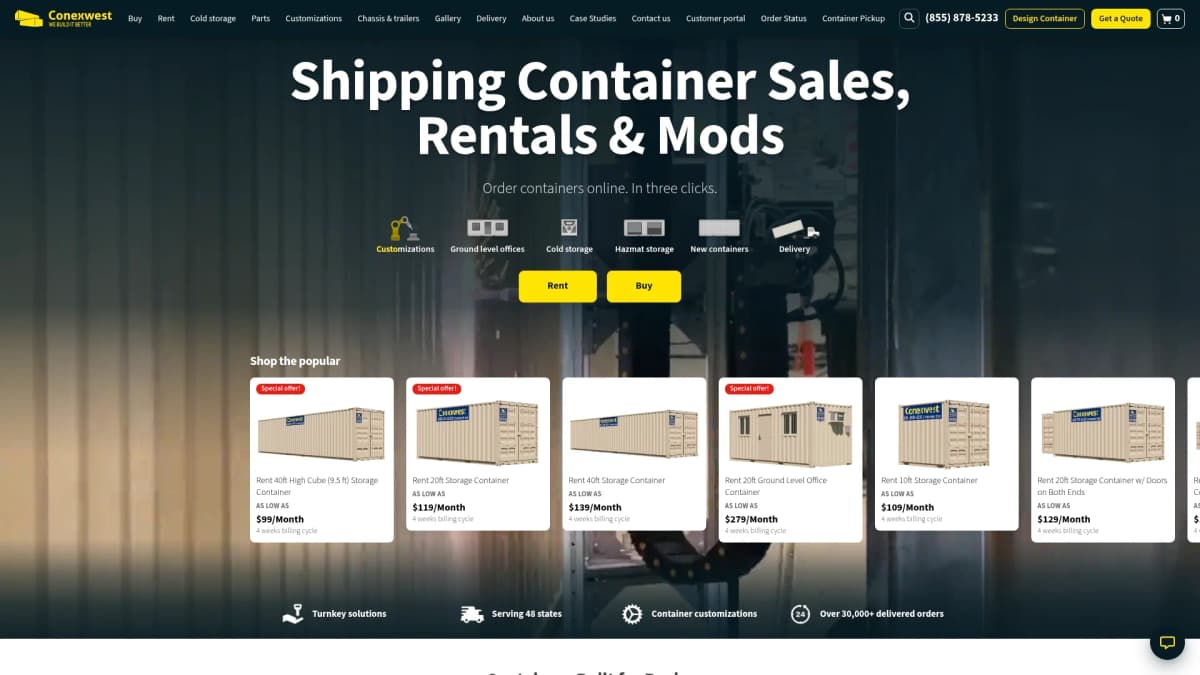
If your project needs cold storage with branding that holds up to moisture and temperature swings, our cold storage containers page outlines available configurations. Request a custom quote through either page to get started.
FAQ
What Are the 5 C’s of Branding?
Definitions vary, but a common version includes clarity, consistency, character, credibility, and connection, the idea being that a brand needs a clear message delivered consistently across every touchpoint, including physical assets like a branded container. For container projects specifically, consistency between exterior graphics and interior fit-out details reinforces the same brand character.
How Do You Make a Shipping Container More Attractive?
Surface treatments like vinyl wraps, exterior paint, or cladding transform the flat, corrugated look into a finished facade, while added elements like 3D signage or LED accents create visual depth. Proper surface prep, including rust removal and priming, is what makes any of these finishes look sharp and last.
What Are Some Examples of Brand Packages?
A brand package for a container project typically bundles exterior graphics, such as a vinyl wrap or painted logo, with interior signage and sometimes digital or LED elements for nighttime visibility. Packages scale from simple decal-and-banner combinations for temporary use to full cladding-and-interior-fit-out packages for permanent installations.
What Are the Labeling Requirements for Shipping Containers?
Containers used in regulated transport must keep DOT placards visible and unobscured, with 49 CFR 172.502 prohibiting designs that could be confused with placard markings. Containers holding hazardous materials in a workplace setting also fall under OSHA’s HCS 2012, which requires grouped hazard information on labels or accompanying shipping papers.
What Container Options Does Conexwest Offer for Branding Projects?
We offer shipping containers for sale, storage containers for rent, and office containers, each of which can be customized with paint, cladding, or fit-out work before delivery. Pricing for customization work is available on request.
Sources
- eCFR :: 49 CFR 172.502 – Prohibited and permissive placarding.
- 49 CFR § 172.516 - Visibility and display of placards. | LII / Cornell Law
- OSHA standard interpretations on HCS 2012 labeling requirements
- Color contrast and legibility research overview