
Solar-Powered Container Offices and Off-Grid Energy Systems
Solar-Powered Container Offices and Off-Grid Energy Systems
Remote job sites, emergency-response deployments, temporary facilities, and off-grid operations often face the same challenge: the workspace may be ready, but reliable power is not.
Conexwest developed a family of solar-powered container systems for customers who needed lighting, climate control, electrical receptacles, battery storage, and equipment power without relying on a permanent grid connection.
The program included four related builds rather than one identical product repeated several times. The configurations included a completed 20ft solar office, a compact 10ft solar container, an EV-recharging system, and a larger solar-powered container with a finished interior and partitioned layout.
Each project helped refine the next. Solar-panel mounting, wiring routes, battery placement, inverter sizing, HVAC demand, and interior organization all evolved as Conexwest expanded its off-grid capabilities.

Turning a Shipping Container Into an Off-Grid Workspace
The featured build began with a standard 20ft shipping container and was transformed into a finished, solar-powered workspace.
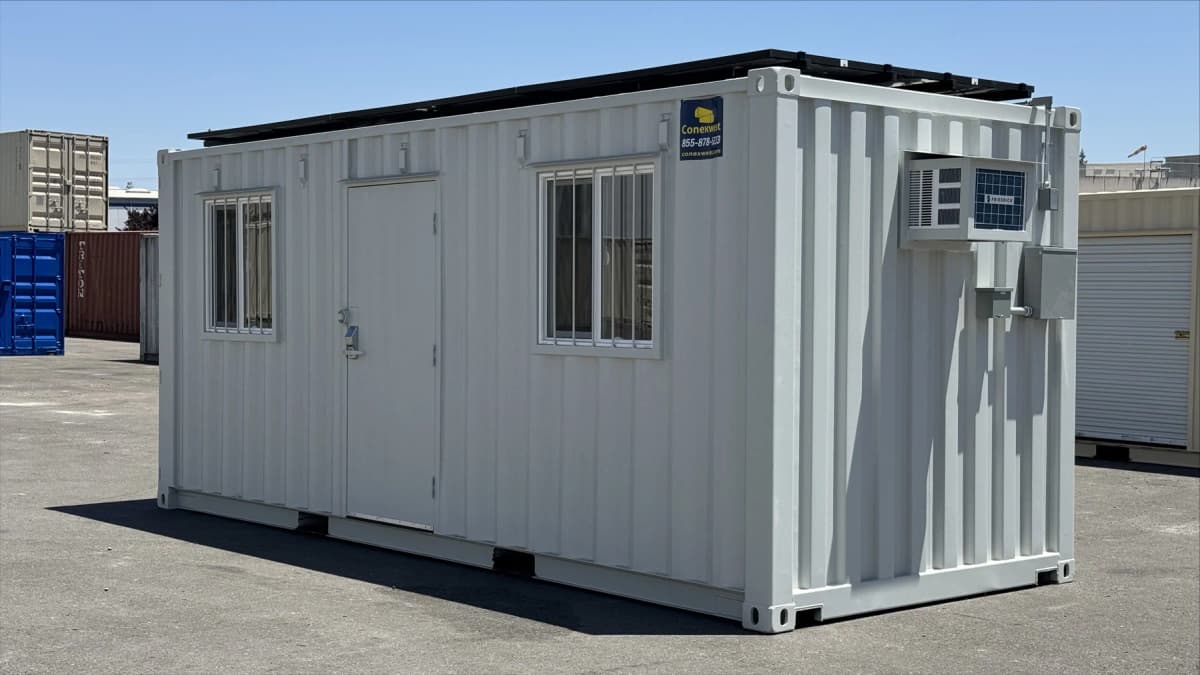
From the outside, the completed unit resembles a compact field office. It includes two secured windows, a personnel door, exterior lighting, a wall-mounted HVAC system, electrical equipment, and solar panels supported above the roof.
Inside, the container includes finished walls, durable flooring, lighting, receptacles, and a dedicated equipment area for battery storage, inverters, electrical controls, and disconnect components.
The finished unit is more than a container with solar panels attached. It is a coordinated workspace and power system designed to support operations without a conventional grid connection.

Starting With the Power Requirements
Every off-grid container project begins by identifying the expected electrical load. Before panel counts or battery capacity can be selected, the project team needs to understand what the unit will power and how long the equipment must operate.
Typical loads may include:
- Interior and exterior lighting
- Electrical receptacles
- HVAC
- Computers and office equipment
- Tools and battery chargers
- Monitoring and control systems
- Specialized field equipment
- EV charging, where applicable
Once those needs are defined, the solar-panel count, battery-bank capacity, inverter size, wiring, electrical distribution, and climate-control system can be planned around the expected use.
This step is especially important because an off-grid system has a limited energy budget. Larger HVAC equipment, specialty loads, overnight operation, or several cloudy days can significantly increase the solar and battery capacity required.
The Featured 20ft Solar Office
The completed 20ft solar office shows how the different systems can work together as one package.
The exterior includes roof-mounted solar panels supported by a raised rail system. Two secured windows bring natural light into the workspace, while the central personnel door provides convenient daily access.
A wall-mounted HVAC unit supports interior temperature control. Electrical boxes and conduit are positioned on the exterior wall so service points remain organized and accessible.
Inside, the battery and inverter equipment are grouped along one wall, preserving the remaining floor area for desks, field equipment, storage, or other operational needs. Finished walls and flooring make the unit feel more like a conventional office than unfinished industrial storage.

Solving the Solar-Panel Mounting Challenge
One of the most consistent challenges across the four projects was supporting the solar-panel system without placing concentrated loads directly on the container roof skin.
A container roof is made from relatively thin corrugated steel and is not intended to support heavy point loads from conventional panel-mounting rails. Attaching the array only to the roof surface could lead to deflection or damage.
Conexwest developed a reinforced mounting approach that transferred the solar-panel loads to the container’s structural top rails. These rails form part of the container’s primary frame and provide a stronger attachment point than the roof skin.
The raised design also preserved space below the panels for airflow, wiring, inspection, and equipment access.
Battery Storage and Power Conversion
Solar panels generate electricity during daylight, but an off-grid office also needs power after sunset and during periods of reduced solar production.
The builds used lithium battery banks to store energy for later use. Depending on the configuration, the systems incorporated multiple 48V batteries, a pure sine wave inverter, a solar charge controller, automatic transfer equipment, disconnects, and digital monitoring.
The batteries supplied stored power to the container’s electrical system. The inverter converted that stored energy into alternating current for lighting, outlets, HVAC, and other connected equipment.
Digital monitoring helped operators track charging, battery levels, and overall system performance. In the completed 20ft office, the batteries and controls were grouped into a dedicated equipment zone to keep the system organized and separated from the primary workspace.

For more information about power, insulation, doors, windows, and interior packages, explore Conexwest’s shipping container modifications and custom container fabrication services.
Climate Control Without Grid Power
Heating and cooling can represent one of the largest electrical loads in an off-grid container. For that reason, insulation and HVAC sizing were treated as part of the power-system design rather than as unrelated upgrades.
The completed 20ft office includes a wall-mounted air-conditioning system. Other configurations may use a mini-split or another climate-control option depending on the container size, local climate, interior equipment, and available solar output.
Insulation helps reduce heat transfer through the steel shell, allowing the HVAC system to operate more efficiently and preserving more battery capacity for lighting, receptacles, controls, and equipment.
The HVAC system must be matched to the solar and battery capacity. An oversized system can consume stored energy faster than the panels can replace it.

Learn more about thermal performance in the Conexwest guide to shipping container insulation options.
Four Solar Container Configurations
The four builds shared a similar off-grid foundation, but each configuration was developed around a different footprint, power requirement, and operating use.
- 20ft Solar Office: A finished workspace with roof-mounted solar panels, battery storage, inverter equipment, secured windows, personnel access, electrical service, insulation, and wall-mounted HVAC.
- Solar Office With Access Steps: A ground-level office configuration equipped with trailer-style steps and handrails to support convenient daily entry where the unit was placed directly on grade.
- Compact 10ft Solar Container: A smaller system designed for projects that needed basic electrical power, equipment protection, or a reduced operating footprint.
- EV Recharge Configuration: A higher-demand system with additional battery capacity and a dedicated 240V output circuit designed around EV-charging equipment.
The concept renderings also show an expandable solar-panel arrangement. Fold-out panel sections can increase the available generation area when deployed while keeping the overall system more compact during transportation or storage.
Project Specifications
- Projects: Four related solar-powered container builds
- Container sizes: 10ft, 20ft, and 40ft configurations
- Peak output: Up to approximately 2,300W
- Solar array: Configuration-dependent rooftop panel systems
- Mounting: Reinforced rails connected to the container’s structural top rails
- Battery storage: Multiple 48V lithium batteries based on the expected load
- Inverter: Pure sine wave inverter
- Controls: Solar charge controller with digital monitoring
- Electrical: LED lighting, GFCI receptacles, dedicated circuits, disconnects, and controls
- Climate control: Wall-mounted or mini-split HVAC
- Insulation: Spray foam or another finished insulated interior package
- Access: Personnel doors, secured windows, and optional steps with handrails
- Special configuration: Dedicated 240V circuit for EV charging
- Interior options: Finished walls, flooring, FRP surfaces, metal partitions, and equipment areas
- Grid connection: Not required for normal off-grid operation
How the Platform Improved Across the Four Builds
Each project gave the fabrication team an opportunity to refine the system.
Solar-panel placement improved as Conexwest evaluated how to maximize the usable roof area while maintaining structural support and service access. Wiring routes became more organized, and battery locations were adjusted to improve accessibility, equipment separation, balance, and interior workflow.
Inverter sizing and HVAC selection were also refined around actual equipment loads rather than generic assumptions.
The completed 20ft office reflects that evolution. The panel array, battery bank, inverter, electrical equipment, windows, personnel door, HVAC, and finished interior appear integrated because they were planned as parts of one operating system.
The Finished Result
The four projects created a flexible platform for off-grid offices, storage units, EV charging, emergency operations, and remote equipment support.
The featured 20ft solar office became a complete workspace with its own power generation, battery storage, electrical distribution, climate control, lighting, and finished interior.
The smaller 10ft configuration showed how the same approach could be adapted to a tighter site, while the expandable solar concept demonstrated how additional panel capacity could be added for larger power needs.
Together, the projects show that solar-powered container systems do not have to follow one fixed layout. The container size, panel arrangement, battery capacity, HVAC system, access points, and interior package can all be adjusted around the location and intended use.
Where Solar-Powered Containers Can Be Used
Off-grid container systems can support many different projects, including:
- Remote construction sites
- Emergency-response operations
- Utility and telecommunications projects
- Temporary field offices
- Off-grid events
- Security stations
- Equipment storage
- Field laboratories
- Renewable-energy sites
- EV-charging locations
- Agricultural operations
- Disaster-recovery deployments
The right configuration depends on the expected electrical load, operating hours, climate, site conditions, available sunlight, and backup-power requirements.
Built Around the Power Your Project Needs
Conexwest designs and fabricates custom container systems for remote offices, industrial equipment, emergency operations, utilities, equipment storage, and other specialized applications.
Available modifications can include solar panels, battery banks, inverters, electrical systems, insulation, HVAC, secured windows, personnel doors, interior partitions, finished walls, flooring, equipment mounts, access steps, and specialty circuits.
A shipping container provides the structural shell. The power system, interior layout, and custom modifications determine what the finished unit can do.