
Permit requirements vary dramatically between jurisdictions. Most municipalities consider permanently placed containers as "accessory structures" subject to the same regulations as sheds or garages. Call your local building department to explain your plans and ask what permits are required for your specific property.
20ft Shipping Container Workshop: Layout, Storage & Cost
20ft Shipping Container Workshop: Storage, Layout & Cost Guide
Key Takeaways
- A 20ft shipping container provides 160 square feet of weather-resistant, portable workshop space for all your DIY projects.
- Smart zoning and vertical storage systems can triple usable space in narrow container layouts.
- Proper insulation and ventilation prevent condensation that can damage tools in metal containers.
- Conexwest delivers quality containers nationwide within 3–7 business days with optional pre-modification services for workshop conversions.
Why Shipping Containers Make Perfect Workshops
A 20ft shipping container delivers approximately 160 square feet of workspace (8ft wide by 20ft long) in a weatherproof, portable package built to withstand decades of harsh conditions.
These steel structures were designed to protect cargo during ocean crossings, making them naturally resistant to elements, secure against theft, and surprisingly affordable.
The modular nature means you can start with a single unit and expand later by adding containers or connecting structures as your needs grow. Many DIY enthusiasts appreciate the industrial aesthetic, which pairs perfectly with workshop activities.
The most compelling advantage is portability. Your entire workshop can move with you if you relocate. This aspect alone convinces thousands of makers to choose containers over permanent structures, especially those who rent property or plan future moves.
Conexwest, a leader in shipping and storage solutions based in Northern California, offers new, used, and refurbished containers from 10ft to 45ft, with fast delivery within 3–7 days and container fabrication options like adding shelves and locks. We serve over 10,000 customers nationwide, including prestigious clients like the U.S. Navy and Google. As an ISO 9001 and AWS-certified company, we ensure top quality and competitive pricing. |
Smart Layout Options for Maximum Productivity
_1.webp&w=1200&q=75)
Strategic zoning transforms narrow containers into efficient multi-purpose workshops.
The 3-Zone Workshop Layout
The most effective container workshops incorporate a 3-zone approach that maximizes functionality within linear space. Divide your 20ft length into distinct work areas based on your craft needs.
For woodworkers, this often means creating a cutting/milling zone, an assembly zone, and a finishing zone—arranged in sequence to minimize material movement.
Consider placing the heaviest, loudest equipment (such as table saws) nearest the entrance to facilitate material delivery and dust management. The middle section works well for assembly tables, where you'll spend most of your time. Reserve the far end for finishing work.
Essential Workflow Considerations
Track the journey of materials from raw stock to finished product, noting each station where work happens. This process mapping reveals bottlenecks and helps determine optimal tool placement.
For most crafts, a linear workflow makes the most sense in a container's rectangular footprint. However, creating small U-shaped work cells can maximize efficiency for repetitive tasks.
Allow at least 3ft of clearance around primary tool working surfaces. Ensure nothing impedes the full movement of materials through tools like table saws.
Power and Ventilation Placement
Install more outlets than you think you'll need, with dedicated circuits for power-hungry tools. Position outlets at both bench height (40") and ceiling height to accommodate various equipment.
Ventilation requires strategic planning in sealed metal boxes. At a minimum, install one exhaust fan near the ceiling at each end for cross-ventilation. For workshops that generate significant dust or fumes, consider installing dedicated dust collection systems vented outside.
Space-Saving Storage Solutions
_1.webp&w=1200&q=75)
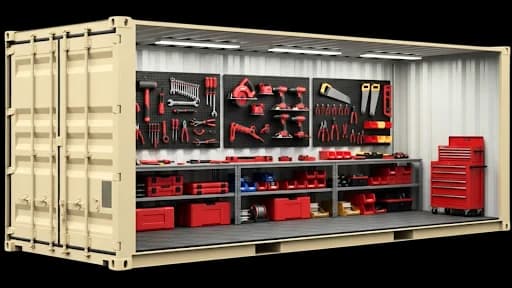
The difference between cramped and spacious container workshops comes down to storage design.
1. Wall-Mounted Tool Organization
Transform every inch of wall space using French cleats, pegboard systems, and slat walls. French cleats offer the most versatility, allowing custom holders for specific tools that can be rearranged. Install cleats horizontally along full wall lengths, spacing them 12" apart vertically.
For smaller hand tools, magnetic strips mounted at eye level keep items visible and accessible. For heavier items like nail guns or drills, install purpose-built brackets directly into the container's steel frame ribs.
2. Ceiling Storage Racks
The often-overlooked ceiling space can store rarely-used items, seasonal materials, or long-term stock such as lumber. Install adjustable overhead racks suspended from the container's ceiling structure using threaded rods.
For lumber storage, ceiling-mounted racks with angled supports allow you to slide material in from the side rather than lifting overhead.
3. Fold-Down Workbenches
Wall-mounted folding workbenches provide full-sized work surfaces that disappear when not needed. Construct these using heavy-duty hinges bolted directly to the container's steel frame, with fold-out legs that lock into place.
Include integrated power outlets and task lighting that remain accessible in both deployed and stowed positions.
Consider a sliding track system where your main workbench moves along the container length to where it's needed for different projects.
Cost Breakdown for a Container Workshop
_1.webp&w=1200&q=75)
Understanding all workshop conversion costs helps create realistic budgets for DIY projects.
Container Purchase Cost
New 20ft shipping containers typically cost $2,349 while used models start at $1,325, depending on condition, location, and market demand. Refurbished units start at $2,379 but offer near-new condition with minimal wear.
When budgeting, factor in container grade. "Wind and water tight" (WWT) containers are the minimum acceptable standard for workshops, while "cargo worthy" certification indicates better structural integrity.
Delivery & Modification
Delivery costs vary widely based on distance from the supplier, typically ranging from $300–$1,500+.
Basic workshop modifications include:
- Windows: $400 and $700+ each
- Personnel doors: Starting at $900
- Electrical systems: $500–$2,000
*These numbers are estimates, and the actual price can vary. Thus, it’s best to reach out to us for an accurate quote.
Choose Conexwest For Your Container Workshop
As an ISO 9001 and AWS-certified company, we deliver within 3–7 business days with container fabrication options available.
At Conexwest, we specialize in supplying containers for workshop conversions nationwide. Our inventory includes new, used, and refurbished 20ft containers perfect for DIY spaces.
Here’s what we provide:
- Quality Container Selection: We inspect every container for structural soundness, functioning doors, and minimal corrosion.
- Fast Nationwide Delivery: We deliver throughout the United States within 3–7 business days from order confirmation. Our logistics network reaches urban and rural properties across all regions.
- Container Fabrication Services: We offer pre-modification services, including cutting window and door openings, installing ventilation systems, preparing electrical conduits, and applying weather-resistant coatings.
- Competitive Pricing: Our transparent quotes include no hidden fees for delivery or placement. We provide guidance on which modifications offer the best return on investment.
- Expert Support: Our team provides consultation on container selection, layout planning, and local code requirements. We help identify cost-effective approaches for your specific workshop needs.
Was this helpful?
Frequently Asked Questions
Yes, but with important caveats. The more modifications you make, especially structural cuts for windows and doors, the more preparation is required for safe transport. External additions, such as awnings, must be removed, and internal fixtures should be secured or dismounted. Disconnect and properly cap electrical and plumbing connections.
With proper maintenance, a shipping container workshop lasts 25–30 years in most climates. The determining factor is how effectively you prevent and address rust. Containers in coastal environments face accelerated corrosion from salt air, potentially reducing lifespan to 15–20 years without aggressive rust prevention.
Yes, we specialize in supplying containers for workshop conversions nationwide. We provide detailed consultation on container selection based on your specific needs, craft type, and modification plans.
Our team helps determine which container grade works best for your budget, what modifications make sense to complete before delivery versus on-site, and how to maximize functionality in 160 square feet.