
Reefer Versus Walk In Cooler for Your Site
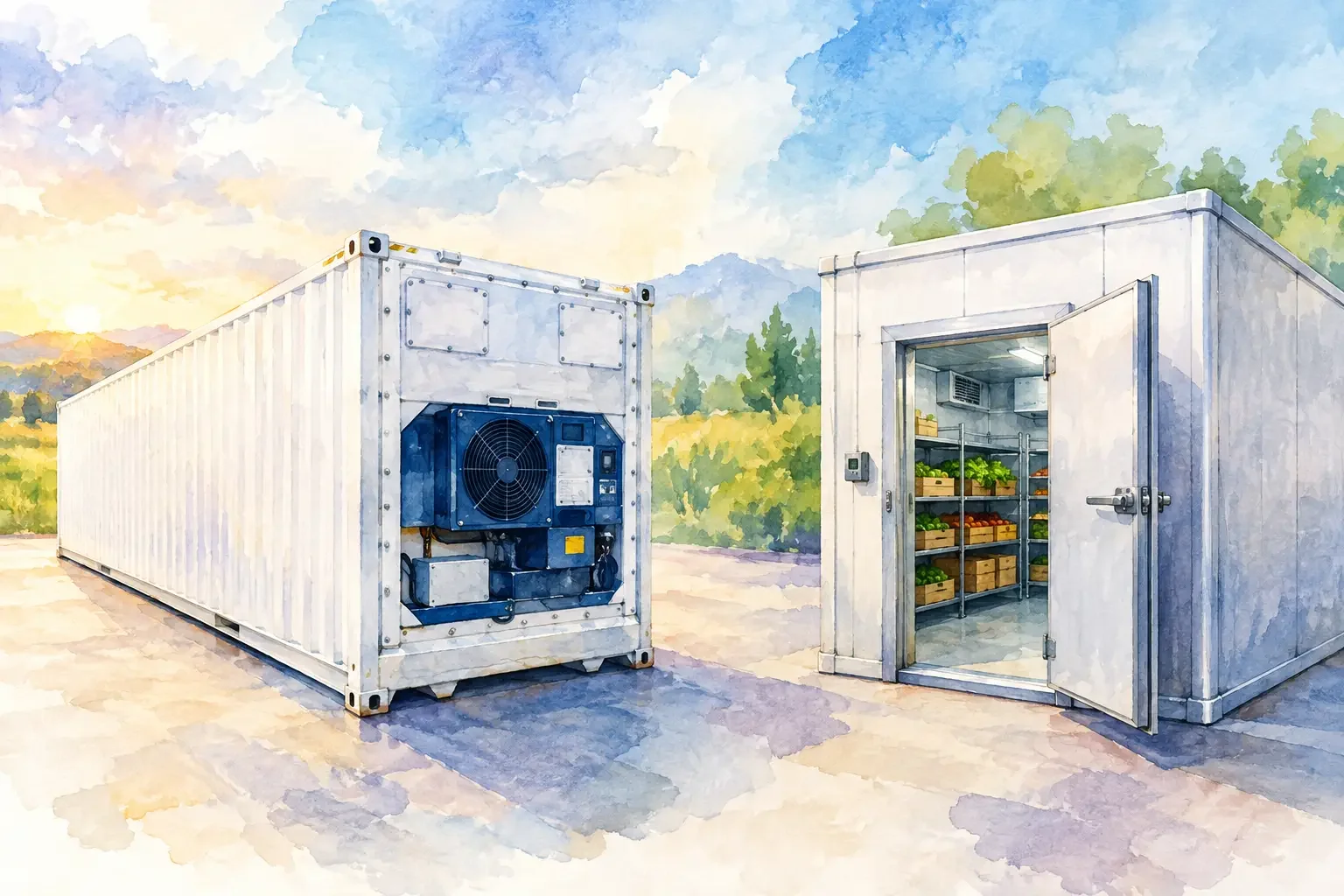
A grocery distributor needs overflow cold storage before a seasonal rush. A caterer needs a secure cooler at an event site by Friday. A food processor needs added refrigerated capacity without shutting down production. In each case, the reefer versus walk in cooler decision affects more than temperature. It determines how quickly the space can be deployed, where it can sit, how it is powered, and whether it can move when operations change.
A refrigerated shipping container, commonly called a reefer, is a transport-ready insulated container with an integrated refrigeration unit. A walk-in cooler is a permanent or semi-permanent insulated room built within a facility or assembled on site. Both can protect temperature-sensitive inventory, but they solve different operating problems.
Reefer Versus Walk In Cooler: The Core Difference
The simplest distinction is mobility. A reefer is a self-contained cold-storage asset built around an intermodal steel container. It arrives as a complete exterior shell, typically placed at ground level and connected to suitable electrical service. When a site layout changes, the unit can be relocated or returned from a rental fleet.
A walk-in cooler becomes part of the building or site where it is installed. It uses insulated panels, a refrigeration system, doors, and sometimes a constructed floor. That approach can create a highly tailored cold room, especially when a business needs a specific footprint, interior layout, or direct access from a kitchen, warehouse, or production line.
Neither option is automatically better. The right choice depends on whether the primary requirement is portability and fast deployment, or an integrated cold room designed around a fixed facility.
When a Reefer Is the Better Operational Fit
Reefers are often the practical answer when cold-chain capacity is needed outside the building envelope or when a project has a defined end date. They are used at construction sites, farms, distribution yards, breweries, food-service events, processing facilities, grocery locations, and emergency response operations.
Because the insulated enclosure and refrigeration machinery are already combined, a reefer reduces the field work associated with building a cold room. The delivery crew places the unit on a stable, accessible surface. The customer provides the required power connection and plans loading access. That can be materially faster than framing, panelizing, running refrigeration lines, and coordinating multiple trades inside an occupied facility.
The steel exterior also matters in exposed environments. Reefers are designed for intermodal transport and provide a lockable, weather-resistant enclosure for inventory. For operations that receive palletized product by forklift, the container format can be familiar and efficient. Standard container lengths such as 20-foot and 40-foot units make capacity planning more predictable, although usable space should always be evaluated against pallet dimensions, aisle needs, and product rotation requirements.
A reefer is particularly strong in these situations:
- Seasonal overflow storage, such as harvest, holiday, or peak-demand inventory
- Temporary capacity during a renovation, equipment replacement, or facility expansion
- Remote operations where building a permanent cooler is not justified
- Projects that require cold storage to move between job sites, yards, or regions
- Secure exterior storage for boxed, palletized, or bulk refrigerated goods
There are trade-offs. A reefer needs appropriate electrical service, and the refrigeration unit requires clearance for airflow and service access. Container doors open from one end, so product flow may not be as convenient as a walk-in designed with multiple doors or direct interior access. If staff will make frequent small picks throughout the day, loading practices and door-open time deserve close attention.
When a Walk-In Cooler Makes More Sense
A walk-in cooler is usually the stronger long-term choice when refrigeration must be built directly into the way a facility operates. Restaurants, commercial kitchens, grocery back rooms, laboratories, floral operations, and food-production plants may need staff to enter the space constantly, retrieve small quantities, use shelving on several walls, or pass product through from one room to another.
Its primary advantage is design flexibility. A walk-in can be sized around available square footage, ceiling height, doorway locations, racks, drains, and internal traffic patterns. It can accommodate a layout that a standard container footprint cannot. It may also be easier to integrate with existing building systems and workflow, especially where products move continuously from receiving to prep, processing, or display.
That customization comes with greater site dependency. Installation can require slab evaluation, panel assembly, refrigeration work, electrical coordination, permits, and code review. The exact scope depends on the building, jurisdiction, cooler size, refrigeration system, and intended use. Once installed, a walk-in is not an asset that can be simply loaded onto a truck and moved to the next location.
For a stable facility with predictable long-term demand, those installation requirements may be justified. For a facility that is leased, under renovation, or likely to expand, they can create avoidable cost and schedule risk.
Compare Capacity by Workflow, Not Just Square Feet
Buyers often start with the question, “How much can it hold?” That is necessary, but capacity alone can lead to the wrong configuration. The more useful question is how inventory enters, moves, and leaves the cold space.
A 40-foot reefer can offer substantial pallet storage, but its long, narrow format requires a thoughtful loading plan. It works well for reserve inventory, full pallets, bulk cases, and products with a clear first-in, first-out sequence. If a forklift will load the unit, confirm door clearances, ramp requirements, floor loading, turning space, and the condition of the receiving surface.
A walk-in can use a wider footprint and be configured for pick faces, shelving, rolling carts, or multiple access doors. That may improve labor efficiency for high-frequency picking even if its total storage volume is lower. In other words, the cold room with the most cubic feet is not always the cold room that moves the most product per shift.
Temperature range also needs a product-specific review. Refrigerated goods vary widely in their acceptable storage conditions. Produce, beverages, dairy, prepared foods, pharmaceuticals, and floral inventory can have different temperature, humidity, airflow, and sanitation needs. Confirm the equipment's operating capabilities against the product specification rather than assuming that any cold space is suitable.
Installation, Power, and Site Readiness
A reefer can be deployed quickly, but it is not a plug-and-forget solution. Before delivery, assess truck access, gate width, overhead obstructions, placement clearance, surface condition, and the intended direction of the doors. The site needs a level, stable foundation that supports the unit and allows doors to operate safely.
Power is a central consideration. Reefer refrigeration equipment commonly requires a dedicated electrical connection appropriate to the specific unit. Verify voltage, phase, amperage, disconnect requirements, cord reach, and local electrical requirements before delivery. A qualified electrician should confirm the connection, particularly for sites using generators or temporary power.
Walk-ins require the same discipline, with additional construction coordination. Refrigeration equipment placement, condensate management, interior lighting, floor conditions, fire and building requirements, and sanitation standards may all affect the final design. The benefit is a cooler tailored to the building. The cost is that every facility constraint becomes part of the project.
Cost Should Include the Operating Timeline
Comparing purchase price alone can distort the reefer versus walk in cooler decision. A reefer may reduce upfront construction scope and provide a rental path for temporary demand. It also retains mobility, which can protect the investment when operations relocate or a project ends.
A walk-in can be a sound capital investment when it supports permanent, high-volume workflow inside an existing operation. However, its real cost includes site preparation, installation labor, utility work, permitting, refrigeration commissioning, and the operational impact of construction around an active facility.
Think in terms of total project duration. For a three-month overflow requirement, a rental reefer can be more logical than building permanent infrastructure. For a production facility that will occupy the same space for years and requires continuous employee access, a custom walk-in may produce better daily efficiency.
Choose the Cold Storage Asset That Can Keep Up
Start with the operational constraint that cannot move: the product, the site, the schedule, or the workflow. If the requirement is fast, secure, relocatable capacity, a refrigerated container gives the project a durable cold-storage asset without turning it into a building project. If the requirement is a permanently integrated room with custom access and layout, a walk-in cooler may earn its added installation effort.
For projects with uncertain timelines or changing site conditions, configure the cold storage solution around flexibility first. Capacity can be added later. A missed delivery window, inadequate power plan, or poor loading layout is much harder to correct once refrigerated inventory is already waiting at the gate.