
How to Ventilate Storage Containers Properly
A locked steel container can hold onto heat, humidity, odors, and condensation long after outdoor conditions change. Knowing how to ventilate storage containers helps protect inventory, reduce moisture-related damage, and make the space safer and more workable for crews accessing it throughout the day.
Ventilation is not a one-size-fits-all modification. A 20-foot container storing boxed tools has different airflow needs than a 40-foot unit used for landscaping equipment, chemical products, battery charging, or a jobsite workshop. The right approach starts with what is inside the container, how often people enter it, and the climate at the site.
Start With the Problem You Need Ventilation to Solve
Most storage container ventilation projects address one or more of four conditions: heat buildup, condensation, persistent moisture, or fumes. Natural vents can improve passive airflow in many standard storage applications. More demanding uses may require powered exhaust, intake louvers, insulation, or HVAC as part of a complete container modification.
Heat is often the first issue buyers notice. Direct sun can make a dark steel roof significantly hotter than the ambient air, and a closed container can retain that heat for hours. Venting lets hot air escape, but it will not create air conditioning. If personnel need to work inside for extended periods, or if stored materials have a narrow temperature range, mechanical cooling and insulation may be the more reliable solution.
Condensation requires a different diagnosis. It occurs when warm, moisture-laden air reaches a cooler steel surface and deposits water droplets. This can affect cardboard packaging, lumber, textiles, electronics, tools, and metal inventory. Ventilation helps exchange humid air, but it may not fully solve condensation in wet or coastal climates. Insulation, vapor management, desiccants, and keeping goods raised off the floor can be equally important.
Fumes deserve the most caution. Fuel-powered equipment, solvents, paints, welding gases, batteries, and cleaning chemicals may create flammable, corrosive, or harmful vapors. Do not rely on basic passive vents alone for these applications. The container layout, fan type, electrical equipment, make-up air, and material storage practices should be designed around the specific products being stored and applicable safety requirements.
How to Ventilate Storage Containers With Passive Vents
For general equipment or dry-goods storage, passive vents are often the most practical starting point. They use temperature differences and wind pressure to move air through the container without electrical power. Common options include louvered wall vents, box vents, mushroom-style roof vents, and turbine vents.
The key is creating a path for air rather than simply cutting a single opening. Place intake vents low on one end or side of the container and exhaust vents higher on the opposite end. Because hot air rises, high-mounted exhaust openings release the warmest air while lower openings draw in replacement air. On a 40-foot container, spacing the intake and exhaust as far apart as practical improves air movement across the full length of the unit.
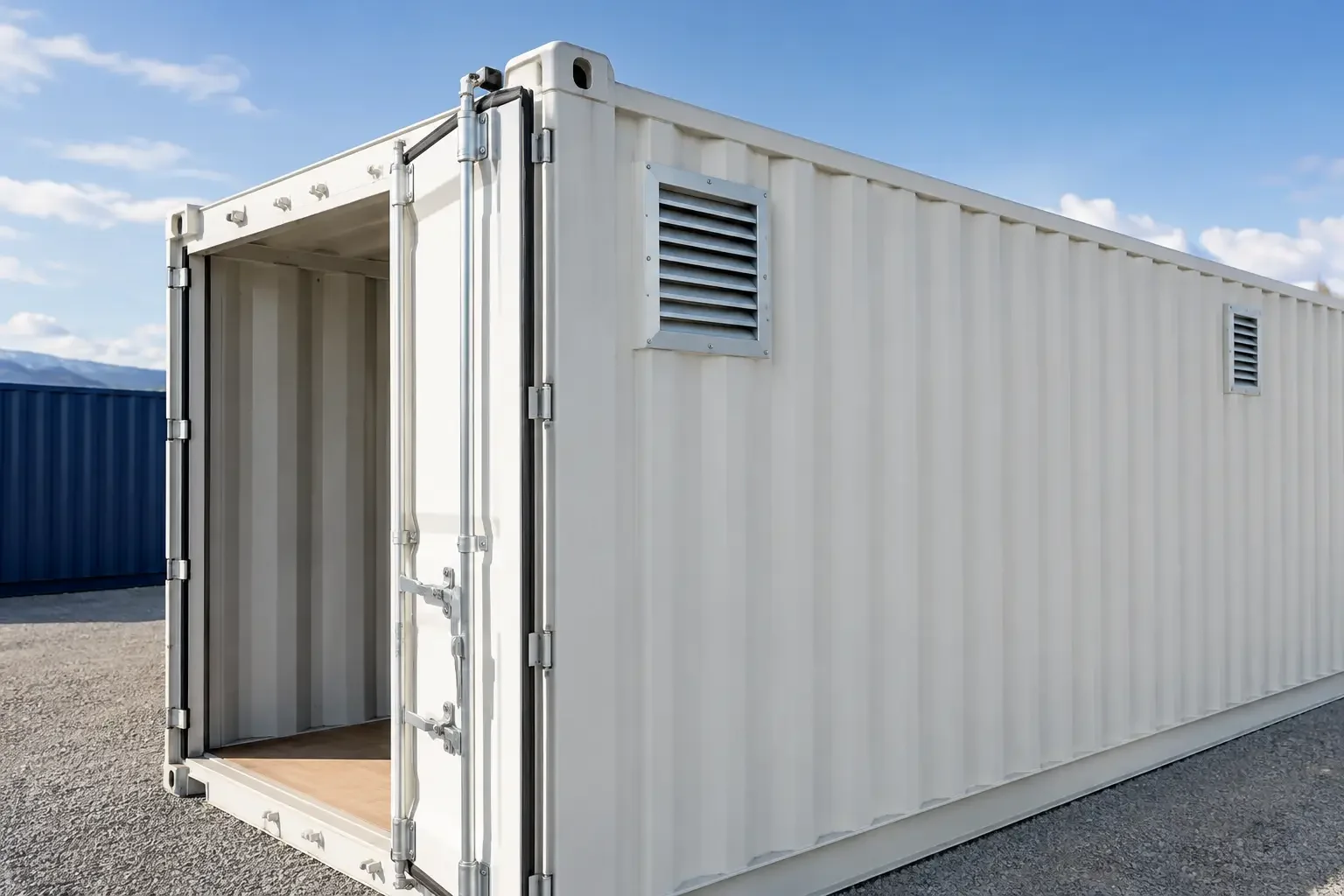
Louvered sidewall vents work well for many storage containers because they can be mounted high on the walls, screened to deter pests, and fitted with weather-resistant louvers. A pair of vents may be sufficient for a lightly used 20-foot container in a moderate climate. Larger units, hot climates, or moisture-prone applications often benefit from multiple vent pairs.
Roof vents can release heat effectively, particularly when the container receives direct sun. They also require careful installation. Every roof penetration must be flashed, sealed, and finished to prevent water intrusion and corrosion. For customers who prioritize a watertight roof or expect to stack containers, high-wall vents may be a better fit.
Passive ventilation has a clear trade-off: it depends on weather conditions. On still, humid days, airflow can be limited. It is a durable, low-maintenance solution for many storage uses, but it cannot guarantee interior temperature or humidity levels.
When Powered Ventilation Is the Better Choice
A powered exhaust fan delivers more consistent airflow when passive vents are not enough. It is commonly used for containers functioning as workshops, battery storage areas, equipment rooms, maintenance spaces, and other applications with regular heat or fume generation.
A basic powered setup usually includes an exhaust fan mounted high on a wall or roof, along with a dedicated intake louver on the opposite side of the container. The intake is not optional. Without sufficient make-up air, the fan cannot move its rated airflow and may create excessive negative pressure that makes container doors harder to operate.
Fan capacity should be selected based on container volume and the intended use. A standard 20-foot container has approximately 1,170 cubic feet of interior volume, while a 40-foot container has about 2,390 cubic feet. For basic heat relief, a fan that exchanges the container air several times per hour may be appropriate. A container with fumes, charging equipment, or process heat may require substantially more airflow and a site-specific design.
Electrical planning matters as much as fan selection. Confirm the available voltage, circuit capacity, disconnect requirements, control method, and exterior weather protection before installation. Thermostatic controls can activate fans when interior temperatures rise. Humidistats can help in moisture-sensitive applications, though they should be used with realistic expectations in regions where outdoor air is consistently humid.
For combustible or hazardous vapors, standard residential or light-commercial fans may not be suitable. Equipment selection and installation should be reviewed by qualified professionals who understand the stored materials, ignition risks, and applicable codes.
Pair Ventilation With Moisture Control
Ventilation is one part of protecting stored goods, not the entire strategy. In many parts of the United States, outside air carries substantial humidity. Bringing more of that air inside may reduce heat while increasing moisture exposure.
Start by keeping water out. Inspect door gaskets, roof seams, corner castings, and floor condition before loading the container. A wind and watertight container is the right baseline for most storage applications. If the unit will be opened frequently during rain or snow, consider a door canopy or adjust loading procedures to limit exposure.
Inside the container, create separation between inventory and the steel structure. Pallets, dunnage, shelving, and wall clearance allow air to circulate and prevent cartons or equipment from sitting against potentially damp floors and walls. Avoid packing items tightly from floor to ceiling if airflow is a priority.
Insulation can reduce surface temperature swings that lead to condensation. Closed-cell spray foam, rigid insulation systems, and insulated wall assemblies are options depending on the intended use. Insulation should be planned before electrical, interior finishes, and shelving are installed so the finished container remains practical and serviceable.
A dehumidifier may help protect sensitive goods when electrical power is available, but it needs a drainage plan and regular service. In an unpowered storage container, desiccant products can provide supplemental moisture control for smaller enclosed areas or packaged inventory, but they are not a replacement for fixing leaks or managing severe humidity.
Vent Placement and Installation Details That Matter
Every opening cut into a steel container changes the enclosure. A well-executed vent modification preserves security, weather resistance, and structural performance while delivering the required airflow.
Locate vents away from door swing paths, shelving plans, and areas where forklifts or stored materials could damage them. Exterior louvers should shed rain, resist wind-driven water, and include mesh or screening where insects and rodents are a concern. Screens need periodic inspection because dust and debris can restrict airflow over time.
Cut edges should be cleaned, primed, and coated to prevent rust. Frames, flashing, sealants, and fasteners should be selected for exterior steel applications. This is particularly important in coastal environments, high-rainfall regions, and industrial sites where corrosion can shorten the service life of an otherwise sound container.
Security also deserves attention. A large louver can become an access point if it is poorly specified or installed. Use appropriately sized vent openings, durable grilles where needed, and placement that does not compromise the container's primary security features.
Build the Ventilation Plan Around the Container's Use
Before ordering a modification, define what the container must do on site. Note the container size, location, orientation, local climate, stored materials, expected occupancy, available power, and whether the unit needs to stay locked for long periods. Those details determine whether passive vents are enough or whether the project calls for a fan, insulation, HVAC, electrical work, or a combination of systems.
For a straightforward storage application, a wind and watertight container with strategically placed louvered vents may provide dependable airflow with minimal maintenance. For a custom workspace or specialized equipment enclosure, ventilation should be coordinated with the full build rather than added as an afterthought. Conexwest can incorporate vents and related modifications during fabrication so the finished container arrives prepared for the conditions it will face.
The most effective ventilation plan is the one that protects the materials inside without creating new problems at the roof, walls, electrical system, or security envelope. Treat airflow as a working part of the container's design, and the unit will perform more reliably from delivery day onward.