
Double Door vs Single Door Container: How to Choose
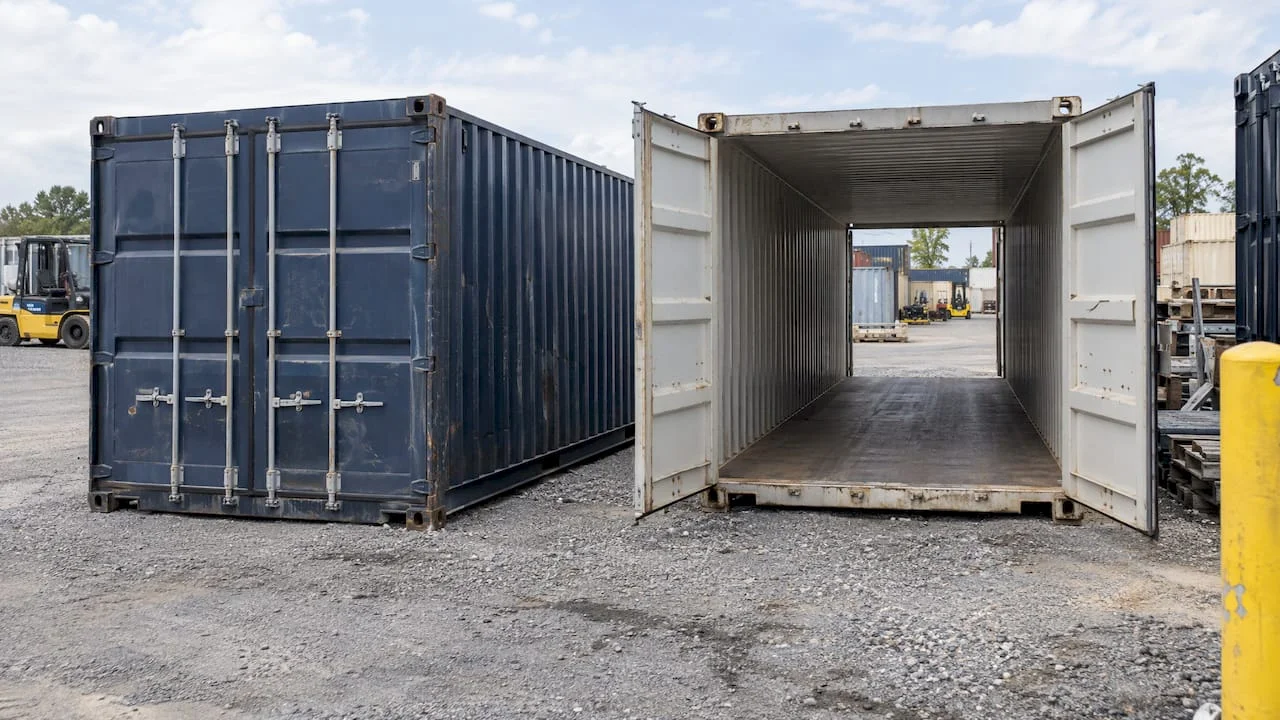
A single-door container opens at one end. A double-door container, also called a tunnel container, has cargo doors on both short ends. Door count does not change how much the container holds.
ISO 668:2020 sets the external width of every Series 1 container at 2,438 mm (8 feet). For the common 20-foot class it requires an internal length of at least 5,867 mm and a door opening of at least 2,261 mm high by 2,134 mm wide, about 7 feet 5 inches by 7 feet. The same pallet can pass either layout. A tunnel container lets you reach the cargo. It does not add cargo space.
Name the layout
Most containers have a pair of cargo doors on one short end and a solid wall on the other. That is the single-door layout. A double-door, or tunnel, layout has cargo doors on both short ends.
Other layouts are separate choices:
- An open-side container has a long door along the side, so you can reach the full length.
- A roll-up door replaces swing doors where a forklift needs a faster opening.
- A personnel door is for people. It is not a second cargo door.
Use two ends when people pull stock all day
With one door, the first item loaded sits at the far wall. The last item sits at the door. To reach the first item, you move what is in front of it. On a 40-foot container the back wall is about 40 feet from the doorway.
With doors on both ends, no item is more than about half the container length from a door. You can stage at one end and pull from the other. Two people can work without crossing. Long items, such as pipe, conduit, or lumber, can go in one end and out the other.
With both ends open, daylight and air pass through. That helps on a hot jobsite. It does not change the weather seal when the doors are closed.
Use one end when you load once, stack deep, and leave the container closed. Use both ends when people or equipment reach items often, when one end will be blocked, or when the load is long.
Example. A crew staging drywall, fasteners, and tools in a 20-foot container for a six-month job opens the box several times a day. Doors at the working end, or at both ends, save the reload. A box that is filled once and opened at the end of the job does not need the second end.
Match the doors to the work
- Construction. Use two ends when crews pull material through the day. Use one end for a locked store that is opened less often.
- Retail overflow. Use the end that faces the stock path. A second end helps when one end sits against a building.
- Parks, cities, and airports. Drive-through doors let a vehicle or a cart enter one end and leave the other without backing out.
- Cold storage. Door count does not set the temperature. Each opening is a place heat enters. Do not add a second cargo end unless the workflow needs it.
- An office or an event unit. People usually need a personnel door. Cargo doors are for loading, not for the daily entrance.
Check these five items
- Clearance. Cargo doors swing out. A standard cargo door swings about 270 degrees. Measure that space at every end that has doors, and leave room for a forklift if you will use one. A double-door container needs that clearance at both ends.
- Ground and the truck path. Level, firm ground keeps the doors aligned. Tell the carrier where each door must face.
- Length first. Choose 10, 20, or 40 feet, then choose the doors.
- Locks. Each door set needs its own lock. On a double-door container, lock both ends every time, even if you use only one.
- Contents. Paper, electronics, and food may need insulation or ventilation. A second door set does not, by itself, change the seal.
A second set of doors can be fabricated. The cut is structural. Confirm it before the container is built, not after it arrives.
Conexwest can supply a single-door or double-door layout on a container for sale, a 20-foot rental, or as dual cargo doors on a modification. A cold-storage unit is a separate choice on the cold-storage page. An office usually needs a personnel door, not a second cargo end.
Questions
Is a double-door container better?
It is better when you must reach cargo from either end or pass through. It is not better when you load once and keep the container closed. It does not hold more.
Are they less secure?
They have a second door set to lock. Lock both ends. With a lock on each set, the container is as secure as a single-door unit.
What is a tunnel container?
It is a double-door container. Cargo doors are on both short ends. With both sets open, you can see through the container.
Can I add a second set of doors?
Yes. The opening is a structural modification. Engineer it and confirm the door swing before fabrication.
Can I rent one?
Yes, when that layout is in the rental fleet. Say you need doors on both ends when you request the unit. A 20-foot container is the common jobsite and retail size.