
Do Container Floors Contain Chemicals? What to Know
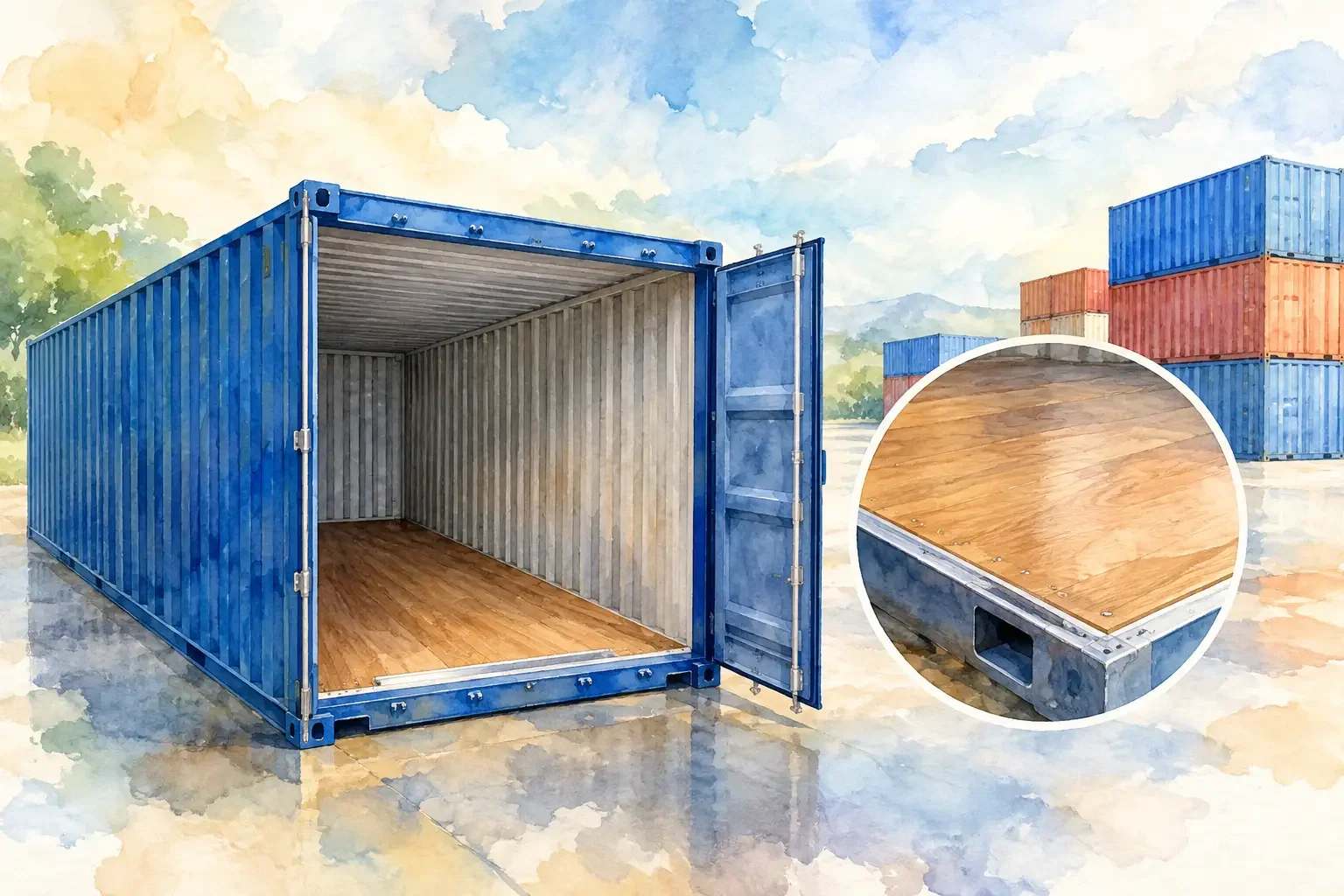
Many shipping containers have a hardwood plywood floor treated to resist insects, fungi, moisture, and decay during international transport.
That does not make every floor unfit. The decision depends on the age, the condition, the prior cargo, and the use.
The floor is often treated
A standard intermodal floor is dense hardwood plywood, often 1.1 inches thick. It is built for forklift traffic, point loads, weather, and ocean transport.
To limit pest transfer between countries, the wood may be treated with a preservative, an insecticide, or a fungicide.
The method and the chemical vary by manufacturer, date, and country of origin.
Some containers have a mark or a paper that names the treatment. A used unit often does not.
A visual check cannot name the chemical or confirm that residue is present.
Used containers also have an unknown cargo history. Stains, odors, corrosion, residue, or damaged plywood are reasons to evaluate the floor before a sensitive use.
Why the wood is treated
The floor sees humidity, temperature swings, salt air, forklift tires, pallet jacks, and heavy cargo.
Untreated wood is more open to insects, mold, decay, and wear on a long voyage and in outdoor storage.
For freight and for many industrial uses, the treatment is part of the floor design.
The original floor can be a poor finished surface for some interiors.
An intact treated floor can suit a construction site, a tool yard, an agricultural equipment enclosure, and many industrial uses.
The floor decision matters more when people stay inside for long periods, when a finish will cover the plywood, or when the use is food, medical, education, or hospitality.
A new floor and a used floor raise different questions
A new or one-trip container has a clearer history. It has usually made one cargo trip and shows limited wear.
New does not mean untreated. The factory floor may still be treated.
A used floor can show forklift damage, patches, stains, and wear from prior cargo.
If the prior use is unknown and people will occupy the container, replace the floor or isolate it.
Match the floor to the use
For outdoor storage, construction equipment, maintenance supplies, and goods that are not sensitive, an intact floor is often enough.
Still inspect it for structural damage, soft areas, holes, and contamination. The floor must carry the load.
For an office, a break room, a retail kiosk, a studio, or another occupied space, the floor is part of the interior build. That build can include insulation, a subfloor, a finished floor, HVAC, electrical work, and ventilation.
You can isolate the original plywood under a barrier and a new finish. You can remove it when the project requires removal.
Food and beverage, healthcare, childcare, and laboratory-adjacent uses need the most caution. Local health rules, sanitation, indoor air, or a client material spec may apply.
Judge that container as part of the facility design. A coat of paint does not change the floor.
Inspect, and test when the use requires it
For tool storage, focus on floor strength, a wind and watertight shell, and cargo access.
For a customer-facing space, define the finish, the occupancy, the ventilation, and the floor assembly before you select the container.
Inspect the top of the floor and the underside where you can reach it. Ask what is known about the history.
Look for:
- Discoloration
- An unusual odor
- Gouges
- Delamination
- Soft spots
- Repairs
When health rules, a regulation, or a contract apply, testing can be the right step. A qualified environmental professional or an accredited laboratory can set the sample and the analysis. Do not guess the treatment from the look, the age, or the country of manufacture.
Write the decision in the scope: the floor stays, an isolation layer goes over it, or the floor comes out. Do this before framing, electrical work, or finishes start.
Isolate a sound floor, or replace a bad one
Isolation can fit a structurally sound floor in a general office, a workshop, or a commercial use. The plywood stays under a designed subfloor and a finished surface.
Replace the floor when the plywood is badly worn, visibly contaminated, structurally weak, or unfit for the specified use.
A new assembly lets you set moisture resistance, how you clean it, the load, and how it works with insulation or a radiant system.
Coordinate the floor with the doors, the windows, the wall framing, the insulation, the HVAC, the electrical system, and the drainage.
Specify the container from the job
Write down what happens inside, how many people occupy it, whether a forklift or a pallet jack enters, and what environmental control it needs.
For straightforward storage, a cargo-worthy used container with an inspected floor can be the practical unit.
For a finished office or a commercial build, a new or one-trip container with a designed floor assembly reduces uncertainty.
For a sensitive use, put the material requirements and the testing in the specification at the start.
Conexwest can match the container condition, the fabrication, and the delivery to that job.