
https://www.conexwest.com/news/why-are-people-choosing-shipping-containers-homes
Can You Really Build a $38,000 Shipping Container Home?
Can You Really Build a $38,000 Shipping Container Home?
If you are an avid TikTok user in the United States, you have most likely seen the video. Almost everybody has.
A couple in Cedar Park, Texas went viral last September for posting a 47-second video of their finished shipping container home on TikTok, with the catchy title, “Our first home. $38k. No mortgages.” Two 40-foot high-cubes welded side by side, a pitched roof, a honey-stained wraparound deck.
The video went viral, with thousands of people commenting and asking, first and foremost, the obvious question: “HOW?” (Yes, really, in all caps.) But it wasn’t without the skeptic half of the internet: contractors and real estate agents calling it fake, staged, and too good to be true.
@lexiiiinewkirk Would you live here ? #shippingcontainerhouse #containerhome #shippingcontainerhome ♬ オリジナル楽曲 - ライディーン
Here is the catch: they are both right, because although the number is real, it is slightly misleading. And no, not because the couple intended to lie, but because the 47-second clip does not explore all the nuances and complexities of the project that should be considered if you are exploring the option of living in a container home.
The $38,000 Figure, Explained
The number checks out. But once you add context, it becomes a very different story.
He is a licensed electrician. She worked in construction throughout her college years. Together, they built roughly 70% of the home themselves, working day and night for seven straight months. Their inner circle stepped in as well, contributing plumbing expertise and other skilled labor.
Then there’s the land. A shipping container home isn’t something you can place just anywhere. Once installed, it becomes a permanent structure, one that requires land ownership, zoning approval, and permits. In this case, land access wasn’t an obstacle. The property was inherited: a half-acre lot outside city limits in Williamson County, where permitting is notably relaxed.
If you subtract any of those variables, already-owned land, trade skills, relaxed jurisdiction, and seven months of sweat equity that $38K starts to climb rapidly. And reality sets in quickly: the container is always the cheapest part.
What the Numbers Look Like in Practice
Real numbers, drawn from real container builds completed within the last 18 months.
Single-container homes — one 40-foot box, roughly 320 square feet after framing and insulation — typically land between $25,000 and $80,000. These estimates assume land ownership, a meaningful amount of owner-performed labor, and a permitting office that isn’t actively hostile. HomeGuide and Angi report comparable figures for 2026.
Multi-container homes — two to three boxes, anywhere from 800 to 1,600 square feet, with proper bedrooms and a fully functional kitchen — generally fall between $80,000 and $250,000+. At the higher end, you’re looking at architect-led designs with premium finishes. At the lower end, savings come from hands-on labor, creative problem-solving, and building in jurisdictions with minimal oversight.
For perspective, the median U.S. home price is hovering around $400,000 in early 2026. Even at the upper end of the container range, that’s a six-figure difference. At the lower end, it can mean avoiding a 30-year mortgage altogether.
The math still works. It’s just not the math people expect.
Where the Money Actually Goes
This is the point where you must align your expectations with reality and address any misconceptions. Let’s review the actual costs involved.
The container itself is the most straightforward cost component. A used 40-foot standard container typically ranges from $2,400 to $4,500. A 40-foot high-cube container, which offers an additional foot of height at 9'6" instead of 8' 6", generally costs between $2,800 and $5,200 used, or $5,500 to $8,000 for a new one-trip unit. Refurbished containers with fresh paint and inspection reports usually fall between $3,500 and $6,000.
And that is the easiest and least expensive part: selecting a container and having it delivered. Now, let’s examine where the process becomes more complex.
Foundation ($8,000–$25,000)
You cannot place a steel container directly on bare ground. Piers are the more economical option, typically ranging from $8,000 to $15,000. A full concrete slab generally costs between $15,000 and $25,000. Soil conditions, frost depth, slope, and seismic requirements all factor into the final cost, and none of them are optional.
Insulation ($5,000–$12,000)
Steel is an excellent conductor of heat and cold. In Texas, an uninsulated container can become excessively hot by midday. In colder climates, it retains freezing temperatures. Closed-cell spray foam is considered the industry standard because it insulates effectively, reduces condensation, the leading cause of mold in container homes and adds structural rigidity. Installed costs typically range from $1.50 to $3.00 or more per square foot. Less expensive alternatives exist, but improperly sealed seams lead to condensation, which can result in mold and costly remediation.
Mechanical systems add up fast
- Electrical typically runs $6,000 to $12,000.
- Plumbing comes in at $8,000 to $18,000, especially once kitchens and bathrooms enter the picture.
- HVAC ranges from $6,000 to $15,000 and in most climates, skipping it isn’t realistic.
Windows and doors ($4,000–$12,000)
This isn’t just hardware. Every opening requires cutting through corrugated steel, welding reinforcement frames, and installing everything correctly so the structure doesn’t warp or fail inspection.
Interior Finishes ($5,000–$20,000)
Drywall, flooring, kitchen cabinetry, and bathroom fixtures can significantly impact the final budget. Costs vary depending on whether the design approach is minimal or more refined.
Additional Project Costs
Then come the less visible but unavoidable expenses.
- Engineering, plans, and permits: $5,000 to $25,000, largely dictated by local building requirements.
- Delivery: $1,500 to $6,000, depending on distance and site accessibility.
- Site preparation and utilities: $3,000 to $15,000. This cost often surprises buyers who purchase rural land without confirming the proximity of power, water, and sewer connections.
The container is the starting point. Site work, utilities, insulation, structural changes, and permitting determine the true cost.
The container you pick matters
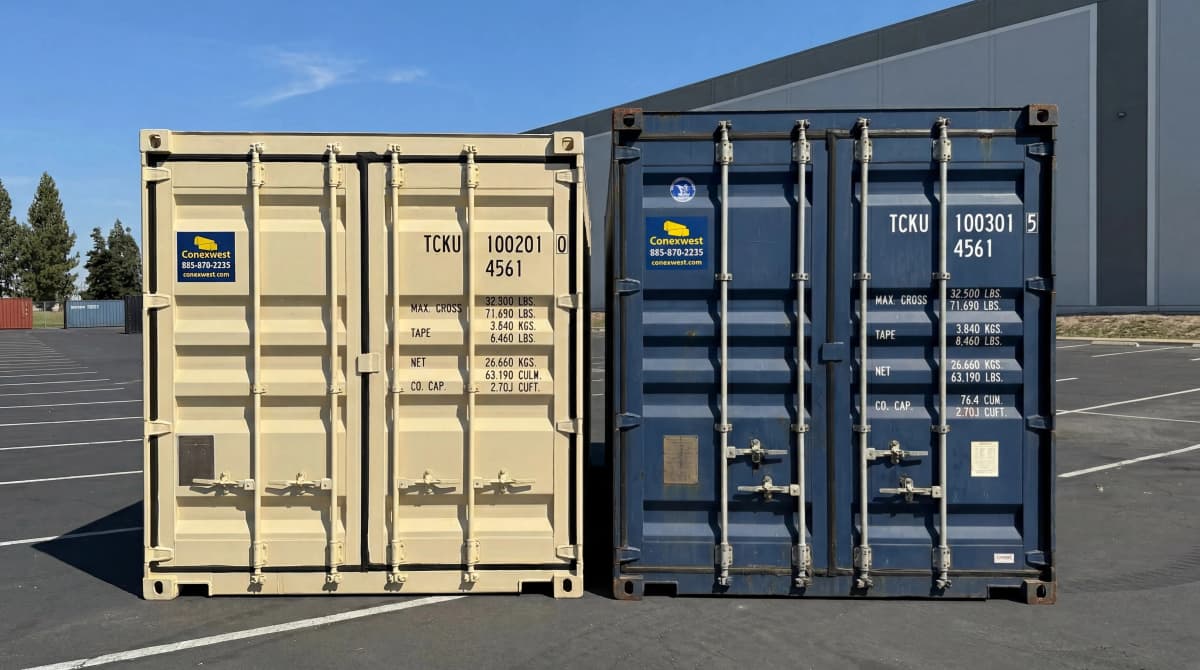
Not all used shipping containers are equal, and cutting corners at this stage can lead to significant remediation costs later.
A container that spent years transporting industrial chemicals overseas differs substantially from one used for dry domestic cargo. Some units have been repaired with mismatched steel panels. Others may have flooring treated with pesticides not suitable for residential conversion. Damaged corner castings — the primary structural load points — can compromise the integrity of the entire container.
For a container home build, look for units rated "Cargo Worthy" or higher. That means the container has been inspected and certified as structurally sound — not just leak-free, but safe to build on. One-trip containers are an even better option: they've made a single journey from the manufacturer and arrive in near-new condition with minimal wear.
Whenever possible, inspect the container in person. Examine the walls and flooring. Check the corner castings. Confirm the unit's prior cargo history.
Insulation Is Not the Place to Save Money
Insulation is one of the most critical cost decisions in a shipping container home build — and one of the most frequently underestimated.
Closed-cell spray foam remains the industry standard because it addresses three critical factors simultaneously: thermal performance, condensation control, and added structural rigidity. Fully installed, it typically ranges from $5,000 to $12,000 for a single container.
Rigid foam board is less expensive and can perform adequately if installed correctly. However, proper installation is critical. Even minor gaps or unsealed seams allow moisture to collect between the steel shell and insulation layer. Condensation inside a steel wall is not cosmetic damage; it can compromise structural integrity over time.
For those who prefer not to manage spray foam installation on-site, Conexwest offers factory-applied insulation during fabrication, ensuring the container arrives fully insulated and ready for build-out. Click here to explore the best insulation options for your container.
In a steel structure, insulation is not a cosmetic upgrade. It is a performance requirement.
Structural Modifications Require Engineering
Every opening cut into a shipping container is a structural decision.
Shipping containers are engineered to carry heavy loads, with strength concentrated in the corrugated steel walls, corner castings, and top and bottom rails. That structural integrity depends on the container remaining intact.
When a window or door opening is introduced, material is removed from a load-bearing system. Each cutout must be reinforced with a properly welded steel frame to redistribute loads and maintain rigidity. Without adequate reinforcement, structural issues may not appear immediately but can develop over time, leading to roof deflection, misaligned doors, and water intrusion.
Improperly reinforced modifications are a common reason container builds fail inspection. Conexwest performs window, door, and roll-up door modifications in-house, ensuring proper structural support and code-compliant fabrication.
Zoning, Permits, and the Legal Reality of Container Homes
Container homes are legal in most of the United States. However, legality does not guarantee an easy permitting process or automatic compliance with local zoning requirements. Each state and municipality maintains its own regulations governing the construction of shipping container homes.
Texas is generally more lenient, particularly outside city limits. California is considered ADU-friendly, which can simplify the permitting process in certain jurisdictions. Other states are gradually adapting to container construction, including Florida, Oregon, Washington, and rural areas in Tennessee, Colorado, and Missouri.
In contrast, dense urban markets such as New York City have historically enforced stricter zoning rules, HOA oversight, and historic preservation requirements.
Permitting timelines typically range from four weeks to four months and can cost up to $10,000, depending on engineering review and local approval requirements.
Skipping permits is not advisable if you want to avoid costly legal and structural complications later. You can learn more about zoning and permit regulations in the United States by clicking here.
“Used” Does Not Always Mean “Bargain”
A used container priced at $2,800 may appear to be a significant savings compared to a new one-trip unit at $6,000. In some cases, it is.
However, used containers can carry less visible risks. Flooring may have been exposed to cargo chemicals. Rust can develop beneath fresh paint. Marine-grade plywood floors are often treated with pesticides that are acceptable for freight transport but may not be ideal for residential use.
A refurbished container — typically sandblasted, inspected, repaired, and repainted — generally ranges from $3,500 to $6,000. The added cost often reduces the likelihood of structural or contamination issues. For a residential build, that tradeoff frequently makes financial and practical sense.
Final Considerations
Container homes tend to make the most financial sense for buyers who already own land, have hands-on construction experience, or are intentionally pursuing a smaller, efficiency-focused build.
That said, financial optimization is not the only reason people choose container construction. Some are drawn to the compact footprint, industrial aesthetic, or the appeal of repurposing a steel structure. For those buyers, the value is not purely cost-driven — it is architectural and practical.
The key is alignment. If the goal is to build a large, conventional 2,500-square-foot home with a garage, traditional framing often becomes simpler and more economical. But if the objective is a smaller, well-engineered structure built with realistic budgeting and proper planning, container construction can be a viable path.
The Bottom Line
The $38,000 container home is possible in the same way a $500 cross-country road trip is possible. It has been done under specific conditions, with specific skills and circumstances that are not easily replicated.
What does hold up is the broader premise: it is possible to build a durable, efficient home for less than prevailing market prices — if the project is planned, engineered, and budgeted realistically. As the gap between housing costs and income continues to widen, interest in alternative construction methods will likely continue to grow.
If you are serious about pursuing a container build, start with the fundamentals:
- Review your local zoning requirements. A short investment of time upfront can prevent months of permitting delays.
- Purchase from a reputable, verifiable supplier. Inspect the unit in person when possible. Confirm its condition and prior use. Browse Conexwest’s nationwide inventory and request a quote.
- Build a realistic budget. Contingency planning matters. Unexpected costs are common in any construction project.
- Learn from completed projects — including the unsuccessful ones. First-hand experiences often reveal more than promotional case studies.
A container home is not a shortcut. It is a construction project. Approach it with the same diligence you would apply to any structural build, and it can perform accordingly.
Ready to Take the Next Step?
Whether you’re planning a container home or another creative project, Conexwest has the experience and resources to help you succeed.
Choose the right container for your vision.
Browse new, used, and refurbished ISO shipping containers — from compact 10 ft units to generous 45 ft high cubes — with transparent pricing and fast delivery nationwide.
Customize with confidence.
From windows and doors to insulation and electrical, Conexwest handles modifications and fabrication in-house, so your container arrives ready for conversion or use.
Design it your way.
Use the ConexBuilder™ tool to visualize custom layouts and features before you order — saving time and ensuring the result matches your needs.
Get expert support.
Have questions or need help specifying your project? Conexwest’s team is ready to assist — from initial quote to delivery and beyond.
Start now! Visit the Conexwest inventory and request a quote to see how your container project can take shape.
Was this helpful?
Frequently Asked Questions
https://www.conexwest.com/news/which-shipping-container-best-your-container-home-new-used-or-refurbished
https://www.conexwest.com/news/are-shipping-container-homes-legal-us-legal-landscape-shipping-container-homes-united-states