
When Does 40ft Pay Off? 20ft vs 40ft Container for Buyers at 25–30 m³
Choose a 20ft container when your cargo is dense or heavy, or your delivery site is tight; choose a 40ft (or 40ft high cube) when your load is bulky, light, and you have room to maneuver. The deciding metric is simple: does your shipment hit its weight limit first, or its volume limit first? This guide breaks down the exact dimensions, weights, pricing thresholds, and a decision checklist so you can answer that question for your own load.
TL;DR:
- A 20ft container offers higher payload-to-volume ratio, making it ideal for dense or heavy cargo that hits weight limits before volume capacity.
- A 40ft container costs about 1.3 to 1.8 times more than a 20ft, offering better value only when volume demands exceed 25 to 30 cubic meters.
- Site access constraints and the number of delivery drops are crucial, as tight spaces favor 20ft containers, while multiple sites may require two 20fts instead of one large container.
- Shipping partially filled 40ft containers wastes fuel and money; optimizing container size to match cargo volume reduces carbon footprint and costs.
- Proper pre-loading planning, including weight distribution and site measurements, prevents damage, delays, and unnecessary expenses during transport and offloading.
Table of Contents
- 20ft vs 40ft Container Dimensions: What You Actually Get Inside
- How Much Weight Can a 20ft or 40ft Container Carry?
- How Many Pallets Fit in a 20ft vs a 40ft Container?
- Cost of a 20ft Container vs a 40ft Container: When Bigger Saves Money
- 20ft or 40ft: Which One Fits Your Shipment?
- Container Variants That Change the Decision
- What to Check Before You Order Delivery
- Loading and Packing: Getting Weight Distribution Right
- Which Container Size Is Better for the Environment?
- How Fast Can You Get a 20ft or 40ft Container?
- Conexwest’s Take on Solving the Size Tradeoff
- Get an Accurate Container Quote
- Why Most Buyers Size Up When They Shouldn’t
- Sources
20ft vs 40ft Container Dimensions: What You Actually Get Inside
The 20ft standard dry container measures roughly 20 feet long, 8 feet wide, and 8.5 feet tall on the outside. Once you account for wall thickness, the usable interior comes to about 5.89 meters by 2.35 meters by 2.39 meters, or roughly 33.2 cubic meters (1,172 cubic feet), according to Freightos.
The 40ft standard dry container shares the same width and height but doubles the length. Interior space works out to about 12.02 meters by 2.35 meters by 2.39 meters, or roughly 67.7 cubic meters (2,389 cubic feet).
Door openings matter more than most buyers expect. Standard doors open to about 2.34 meters wide and 2.28 meters tall on both sizes, and that clearance can block loading for oversized machinery or tall crated items even when the interior has room, per HZ Containers. If you order a 40ft high cube, you gain about one extra foot (roughly 30 cm) of internal height. These figures follow ISO 1496-1 container standards, though small manufacturing tolerances mean two containers of the same nominal size can differ by an inch or two.
How Much Weight Can a 20ft or 40ft Container Carry?
This is where the “bigger is always better” assumption falls apart. A 20ft container typically has a tare weight (the container’s own weight) of about 2,300 kg (5,070 lb) and a maximum payload around 21,700 kg. A 40ft container weighs more empty, roughly 3,750 kg (8,265 lb) tare, but its typical payload runs about 26,730 kg, according to Freightos.
Do the math on payload per cubic meter and the 20ft wins by a wide margin. Its payload-to-volume ratio is noticeably higher, which is exactly why steel coils, tile pallets, canned goods, and machinery almost always ship in 20ft units. Cram that same density into a 40ft and you will hit the legal weight cap long before the container looks full.
Inland transport adds another wrinkle. Highway axle weight limits and local overweight permit rules can cap what you can actually load onto a truck chassis, regardless of what the container itself is rated to hold. Always check your state’s road weight limits before finalizing a heavy load plan.
How Many Pallets Fit in a 20ft vs a 40ft Container?
Volume numbers only mean something once you translate them into pallets and boxes. A 20ft container holds about 10 standard US GMA pallets (48 inches by 40 inches) arranged in two rows of five. A 40ft holds around 20 to 21 GMA pallets, roughly double, since the extra length adds a second full row of capacity without changing the width, per Freightos. Euro pallets (1.2 meters by 0.8 meters) fit slightly differently depending on orientation, but the same 2x ratio between container sizes generally holds.
Real-world sizing looks like this:
- A one- to two-bedroom household move typically fits comfortably in a 20ft container.
- A three- to four-bedroom household move usually needs a 40ft, or two 20fts if the move happens in stages.
- A typical palletized retail restock (10 to 12 pallets of mixed cartons) fits a 20ft with little wasted space.
- Bulk furniture, appliance, or e-commerce fulfillment shipments generally favor the 40ft or 40ft high cube for headroom.
Cost of a 20ft Container vs a 40ft Container: When Bigger Saves Money
Here’s the number most buyers get wrong: a 40ft container does not cost double a 20ft. Market data shows the price gap typically runs about 1.3 to 1.8 times the cost of a 20ft, not 2x, according to a seller analysis on Alibaba. That gap is what makes the 40ft such a strong value once your shipment volume surpasses a certain point.
The rule of thumb: once your cargo volume approaches a moderate threshold of cargo volume, a 40ft typically becomes more cost-efficient on a per-cubic-meter basis. Below that threshold, a 20ft usually wins on total cost even though it holds less.
A few other cost factors shift the calculation beyond the sticker price:
- Inland trucking rates sometimes differ between 20ft and 40ft chassis availability in your region.
- Shipping two 20fts instead of one 40ft means two deliveries, two sets of drayage fees, and two demurrage clocks if either gets held up.
- An underfilled 40ft still costs more than a right-sized 20ft, so don’t upsize “just in case” without a real volume estimate.
20ft or 40ft: Which One Fits Your Shipment?
Run through this checklist before you order:
- Calculate your cargo density. Divide total weight by total volume (kg/m³). Loads above roughly 800 kg/m³ tend to hit weight limits before volume limits, which points toward 20ft, per ContainerEU.
- Check site access. Tight driveways, sharp turns, or limited yard space often rule out a 40ft delivery truck.
- Count your delivery drops. A single site favors one container of either size; multiple sites often favor two 20fts for modularity.
- Set your budget ceiling. If your volume sits below 25 to 30 m³, a 20ft usually costs less overall even at a higher per-unit price.
Dense machinery, tile, and canned goods point to 20ft. Palletized cartons, retail restocks, and household moves past three bedrooms point to 40ft. Two 20fts also make sense when you need to split inventory across two job sites or want the flexibility to relocate one unit without touching the other.
Pro Tip: If you’re on the fence, order the 20ft. It’s easier to add a second unit later than to have paid for wasted space in a 40ft you never filled.
Container Variants That Change the Decision
The 40ft high cube adds about one extra foot of height, pushing internal volume from roughly 67.7 m³ to closer to 76 m³, according to ContainerEU. That extra headroom matters most for tall pallets, stacked furniture, and equipment that would otherwise need to lie on its side.
Open-side and tunnel containers solve a different problem: side or end access for oversized items that won’t fit through a standard end door. If you’re loading vehicles, boats, or long structural steel, a specialist unit like this often beats forcing the load through a standard 20ft or 40ft opening.
Refrigerated and ventilated units carry their own tradeoff. Insulation and cooling equipment add weight and eat into usable interior volume, so a reefer’s effective payload and cubic capacity both run lower than a standard dry container of the same nominal length.
What to Check Before You Order Delivery
A 40ft delivery truck needs a longer straight-run approach and a wider turning radius than a 20ft rig. Measure your driveway or yard before ordering, not after the truck shows up and can’t make the turn.
Ground conditions matter too. Soft soil or an unpaved surface can cause an unevenly loaded container to settle, so a compacted gravel or paved pad is worth the prep time, especially for a heavier 40ft.
Offloading method depends on your equipment. A tilt-bed or flatbed truck can set a container down without a crane on most flat sites, but if ground clearance is limited or the drop zone is uneven, you may need crane assistance, particularly for 40ft units.
Before you finalize a size, call around locally to confirm chassis and truck availability for that size in your area. Regional shortages can add delivery time or cost regardless of which container you choose.
Loading and Packing: Getting Weight Distribution Right
Balance is everything once cargo is inside the box. Distribute weight evenly across the floor and avoid piling heavy items at one end, since an unbalanced load can shift during transport or make a container harder to lift and set down safely.
- Use dunnage (wood blocking, airbags, or straps) to keep pallets from shifting in transit.
- Double-stack pallets only when the bottom layer can support the load without crushing, and never double-stack fragile cartons under heavier ones.
- In a 40ft, pay extra attention to the middle section, where uneven weight has more leverage to rock the container during a turn.
Common mistakes include miscalculating cargo density and picking the wrong size, ignoring door clearance for oversized crates, and improper lashing that lets pallets shift. Fix each with a quick pre-load check: weigh a sample pallet, measure your tallest item against the door opening, and confirm strap points before closing up.
Pro Tip: Photograph your load before closing the doors. If a damage claim comes up later, that photo is your best evidence that the container left your site properly packed.
Which Container Size Is Better for the Environment?
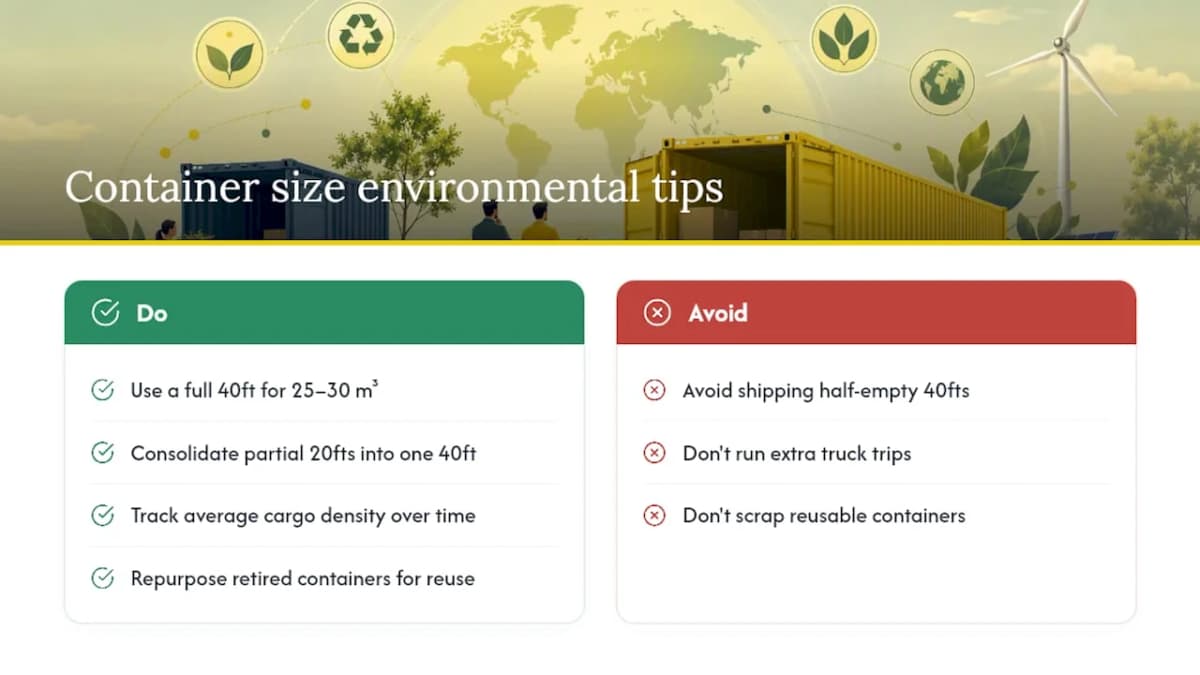
Fewer, fuller containers beat more, emptier ones every time. A single 40ft carrying a full 25 to 30 m³ load moves the same freight as two 20fts with roughly half the fuel burned per truck trip and half the port handling fees, since drayage and inland trucking are priced and fueled per movement, not per cubic meter carried.
The flip side matters just as much: shipping a half-empty 40ft wastes fuel and money compared to a right-sized 20ft. An underfilled container burns the same diesel per mile as a full one, so matching container size to actual cargo volume is one of the simplest ways to cut the fuel cost and emissions tied to a shipment.
Consolidation plays a role too. Combining two smaller, partial 20ft loads into one full 40ft, when timing allows, reduces the number of truck trips and port lifts required to move the same freight. For businesses shipping regularly, tracking your average cargo density over several shipments can reveal whether you’re consistently under-sizing or over-sizing, and adjusting that pattern is a low-effort way to trim both transportation cost and fuel use over time.
Repurposing also extends a container’s environmental value well past its shipping life. Containers pulled from ocean service and converted into storage, offices, or workspace get years of additional use, often stretching total service life to somewhere between 10 and 25 years depending on maintenance and climate exposure, per HZ Containers. Buying that lifecycle extension instead of scrapping a retired container is a meaningful way to lower the footprint of a container purchase.
How Fast Can You Get a 20ft or 40ft Container?
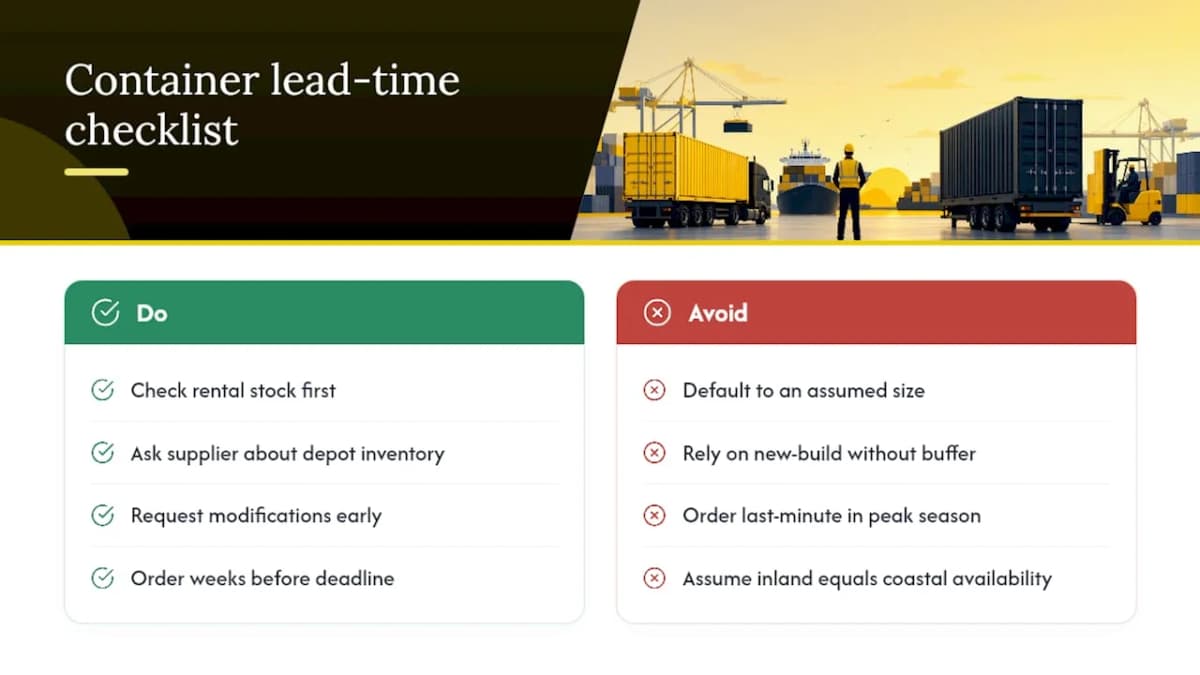
Availability swings by region and by season. Coastal markets near major ports generally have deeper inventories of both sizes, since containers cycle through faster after import unloading. Inland markets farther from a port can see longer lead times, particularly for 40ft units, since fewer chassis are rated and available to move the longer length on local roads.
Rental fleets typically turn around faster than new-build orders, since a rental unit already exists in a depot lot rather than needing fabrication or modification. If you need a container this week, checking rental stock before committing to a custom-built purchase order usually shortens your timeline considerably.
Custom modifications add real time to either size. A container with a roll-up door, added ventilation, or an office conversion needs fabrication time on top of standard delivery scheduling, so requesting those features early in the process avoids a last-minute scramble. Seasonal demand spikes, especially around peak retail shipping months, can also stretch turnaround for both sizes, so ordering a few weeks ahead of a hard deadline gives you more flexibility on price and delivery date.
If your timeline is tight, ask your supplier directly what’s sitting in local depot inventory versus what requires a longer-lead custom order. That single question often reveals a faster path than defaulting to whichever size you assumed you needed.
Conexwest’s Take on Solving the Size Tradeoff
Conexwest built its online ordering system around exactly this tradeoff. Buyers can browse 20ft, 40ft, and high cube inventory, customize doors, ventilation, or office layouts, and place an order in a few clicks rather than negotiating size and specs over email. With more than 30,000 containers delivered across 48 states, Conexwest has handled the delivery-access and modification questions this guide covers, for logistics, education, and government clients alike. If your site has tight access, a custom door opening, or a high cube requirement, that’s exactly when a call to Conexwest pays off before you finalize your order.
Get an Accurate Container Quote
Once you’ve settled on 20ft or 40ft, the fastest way to nail down real pricing is to have your numbers ready before you request a quote. Gather your cargo volume in cubic meters, average weight per pallet, photos or measurements of your delivery site’s access route, and your preferred unit variant, whether that’s standard, high cube, or a custom modification.
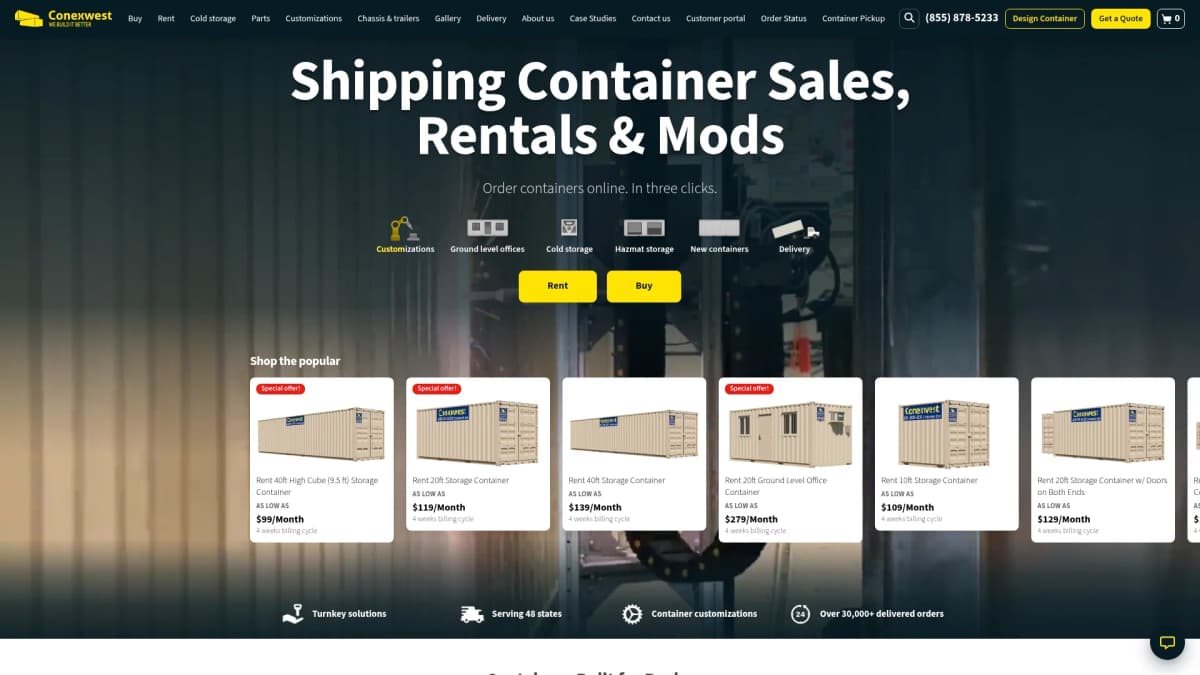
From there, you have two paths. Order directly through the Conexwest online configurator if you already know your size and specs, or request a custom quote if you need door modifications, HVAC, or a specialty layout built to your site’s requirements. Either way, having your access photos and cargo numbers ready means the quote you get back reflects your actual job, not a generic estimate. Start by browsing current container inventory and pricing at Conexwest to see what fits your timeline.
Why Most Buyers Size Up When They Shouldn’t
Most buyers default to the 40ft because it feels like the safer choice, more room means less risk of running out of space. That instinct is backwards for a huge share of shipments. The container industry’s own numbers tell the real story: a 20ft carries a higher payload per cubic meter than a 40ft, which means dense cargo runs out of legal weight capacity long before it runs out of floor space.
The more interesting failure runs the other direction too. Businesses shipping bulky, light freight, think insulation, furniture, or empty packaging, sometimes stick with 20ft out of habit or familiarity, and end up ordering two units when one 40ft would have done the job for 1.3 to 1.8 times the price instead of double. Neither mistake is really about the container. It’s about skipping the five-minute density calculation that would have pointed to the right answer from the start.
If there’s one thing worth internalizing from all of this, it’s that container size is a math problem before it’s a logistics problem. Weigh a sample of your cargo, measure your site access, and run the numbers before you call anyone for a quote. The container industry has standardized dimensions and weight limits precisely so that decision doesn’t have to be a guess.
— Vitali